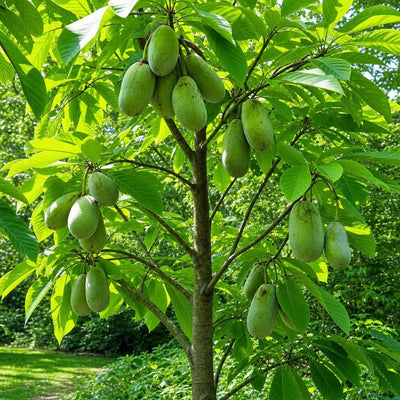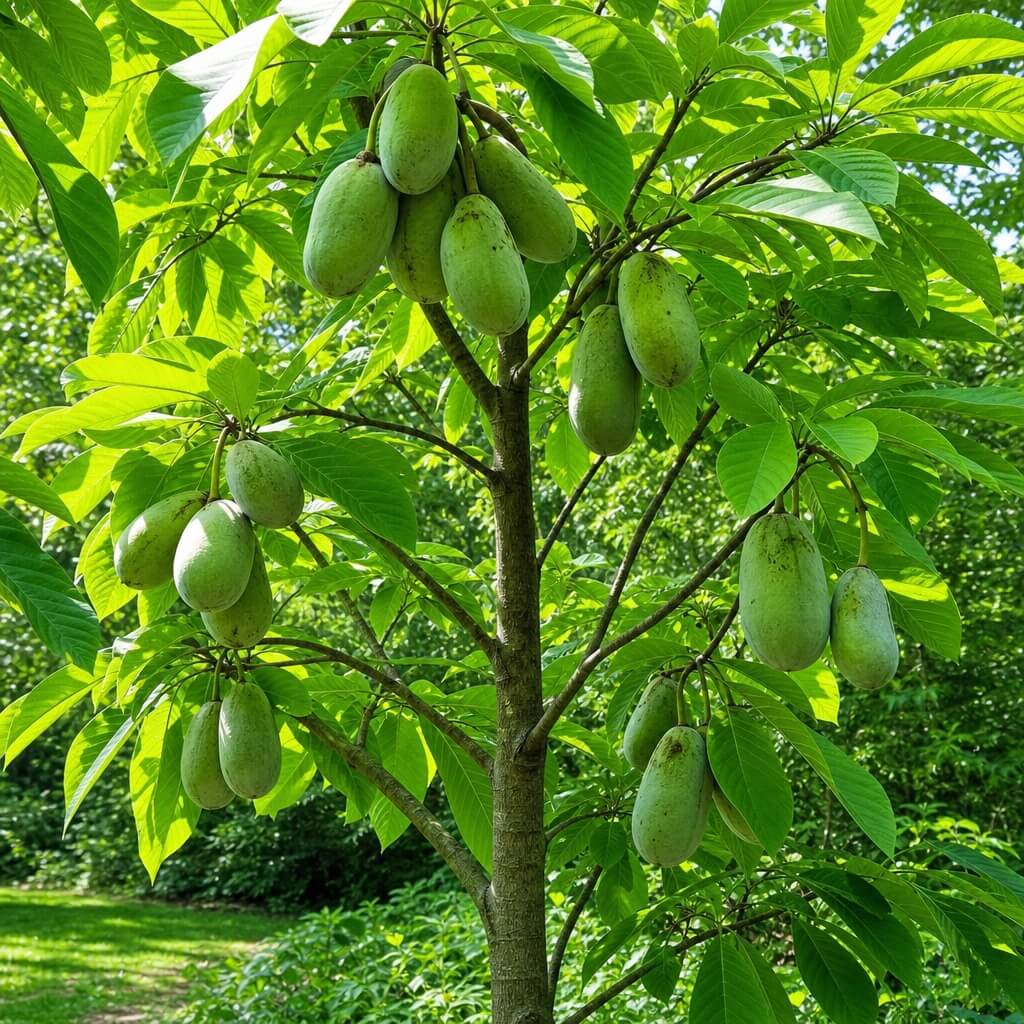
Pawpaw tree identification comes down to four clues: large, drooping leaves 6 to 12 inches long that smell like green pepper when crushed; deep maroon, bell-shaped flowers in April and May; smooth brown bark with gray, wart-like spots; and fuzzy, rust-brown buds with no scales. The pawpaw tree (Asimina triloba) also bears green fruit 3 to 6 inches long.
Late fall is a good time to learn the pawpaw tree: once the golden leaves drop, the fuzzy buds and spotted bark stand out along Tennessee creek banks. Our descriptions below match the Virginia Tech Dendrology pawpaw fact sheet and the NC State Extension Plant Toolbox. Once you can spot one, you may want a grove of your own: our pawpaw trees for sale ship bare root while dormant, from November through April.
What do pawpaw tree leaves look like?
Pawpaw tree leaves are simple, smooth-edged and wider near the tip than the base, 6 to 12 inches long and 2 to 3 inches wide. Pawpaw leaves grow alternately in two flat rows and hang downward from the twig, which gives the tree a drooping, tropical look.
The crushed-leaf test
The quickest pawpaw leaf check is scent. Crush a pawpaw leaf between your fingers and it gives off a fresh green bell pepper smell. In fall, pawpaw leaves turn golden yellow.
What do pawpaw tree flowers look like?
Pawpaw tree flowers are deep maroon to purplish brown, 1 to 2 inches across, with 6 petals. Pawpaw flowers hang face-down like small bells in April and May, before or just as the leaves open.
Flies and beetles carry the pollen, and a second, genetically different tree is needed for fruit. Our guide Do You Need Two Pawpaw Trees for Fruit? explains pollination in detail.
What does pawpaw tree bark look like?
Pawpaw tree bark is thin, smooth and brown, splotched with light gray patches and small, raised, wart-like lenticels. On older pawpaw trunks the bark may turn slightly scaly.
How do you identify a pawpaw tree in winter?
In winter, identify a pawpaw tree by its naked buds: they have no bud scales and are covered in rusty-brown fuzz. The terminal leaf bud is slender, pointed and often slightly curved, about 1/4 to 1/2 inch long. Pawpaw flower buds are small, round and fuzzy. For more trees to practice on, see our winter tree identification guide.
What does pawpaw fruit look like?
Pawpaw fruit is oblong and green, 3 to 6 inches long, shaped like a short, plump banana. Pawpaw fruits hang in clusters of two to nine and ripen from August to October, softening and turning yellow-green as they mature.
Inside, pawpaw fruit has yellow, custard-like flesh and large brown seeds. Learn the ripeness signs in When Are Pawpaws Ripe?, and read our pawpaw fruit guide for flavor and uses.
Pawpaw tree identification at a glance
| Feature | What to look for | Best season |
|---|---|---|
| Leaves | 6–12 in. long, drooping, two rows, green-pepper scent | May–October |
| Fall color | Golden yellow | October–November |
| Flowers | 1–2 in., deep maroon, 6 petals, bell-shaped | April–May |
| Fruit | 3–6 in., green, in clusters | August–October |
| Bark | Smooth, brown, gray patches, wart-like lenticels | Year-round |
| Buds | Fuzzy, rust-brown, no scales; round flower buds | November–March |
| Size | 15–30 ft. tall, 15–20 ft. spread | Year-round |
What trees look like a pawpaw tree?
Cucumbertree, umbrella magnolia and dwarf pawpaw (Asimina parviflora) are the trees most often confused with the pawpaw tree, according to Virginia Tech Dendrology and NC State Extension. The magnolias share the big leaves but not the green-pepper scent, so the crushed-leaf test is the quickest way to confirm a pawpaw.
Pawpaw trees to start with
- Pawpaw Tree: bare-root trees 1–5 ft. tall, sold Buy 1 Get 1 Free, Buy 3 Get 2 Free and in 25-tree packs. Nursery trees usually fruit 4 to 7 years after planting.
- Pawpaw Tree Seedlings: the same native species in packs of 100 or 500 for groves and wildlife plantings, usually fruiting 5 to 8 years after planting.
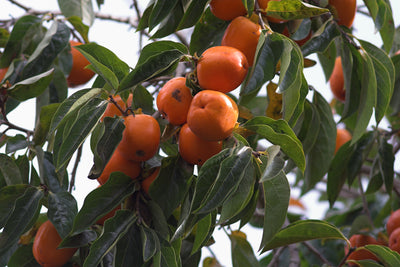
- Persimmon Tree: another native fruit tree that ripens right after the pawpaw harvest.
How do you plant and care for a pawpaw tree?
Plant pawpaw trees while dormant, in moist, fertile, well-drained, slightly acidic soil in USDA zones 5–8. Plant at least two pawpaw trees within 30 feet, spaced 8 to 15 feet apart, in full sun to partial shade.
- Soak bare roots for 30 minutes to an hour.
- Dig a hole twice as wide as the roots and just as deep.
- Set the root collar at soil level, backfill and water deeply.
- Mulch 2 to 3 inches deep, keeping mulch away from the trunk.
For the full process, read our pillar guide How to Grow Pawpaw Trees, and see How Big Do Pawpaw Trees Get? for spacing.
What grows well with pawpaw trees?
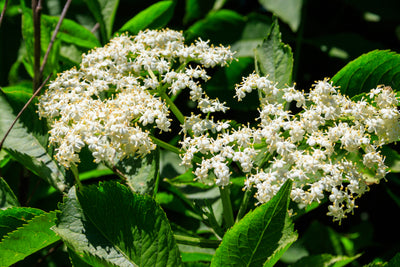
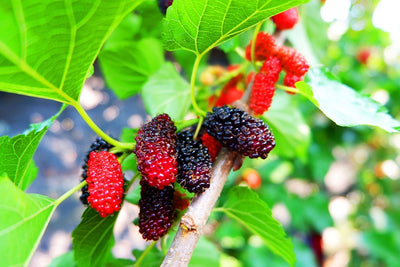
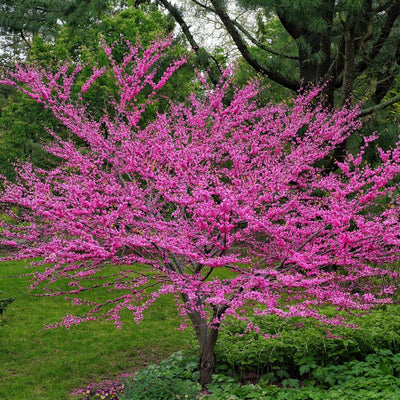
Native fruit trees make good pawpaw companions. An American persimmon ripens in fall after the pawpaws, an elderberry adds summer berries at the grove edge, and a mulberry tree fruits in early summer. A redbud tree blooms beside the pawpaw in April. Pawpaw is also the host plant for the zebra swallowtail butterfly; see our butterfly host plant chart.
Pawpaw tree identification FAQ
What does a pawpaw tree look like?
A pawpaw tree is a small native tree, 15 to 30 feet tall, with a pyramid-shaped to rounded crown and large, drooping leaves 6 to 12 inches long that give it a tropical look. Pawpaw trees often grow in small clusters or groves.
How can you tell a pawpaw leaf from a magnolia leaf?
Crush the leaf. A pawpaw leaf smells like green bell pepper, a scent that sets it apart from look-alikes such as cucumbertree and umbrella magnolia. Pawpaw leaves also hang in two flat rows along the twig.
What color are pawpaw tree flowers?
Pawpaw tree flowers are deep maroon to purplish brown, 1 to 2 inches across, with 6 petals. They hang like small bells in April and May, before or as the leaves open.
What does pawpaw tree bark look like?
Pawpaw tree bark is thin, smooth and brown, splotched with gray patches and small wart-like bumps called lenticels. On older pawpaw trunks the bark may become slightly scaly.
How do you identify a pawpaw tree in winter?
In winter, look for fuzzy, rusty-brown buds with no bud scales. The pawpaw tree's leaf buds are slender and pointed, and its flower buds are small, round and fuzzy, set along the twigs.
Keep reading
- Pawpaw Fruit: What It Is, What It Tastes Like and How to Get It
- How to Grow Pawpaw Trees: Planting, Care and Fruit
- Where Do Pawpaw Trees Grow Best? Zones, Soil and Sun
- How Long Until a Pawpaw Tree Bears Fruit?
From our nursery
TN Nursery is a family-owned, third-generation nursery in Altamont, Tennessee, growing plants since 1959 on 170 acres. Pawpaw is our number one selling tree: we grow about 2 million pawpaw trees a year from about 2 tons of seed, so we see every stage, from fuzzy winter buds to maroon spring flowers. We have supplied plants to landmarks like the Washington Monument and Arlington National Cemetery. When you are ready, buy pawpaw trees straight from our fields.