
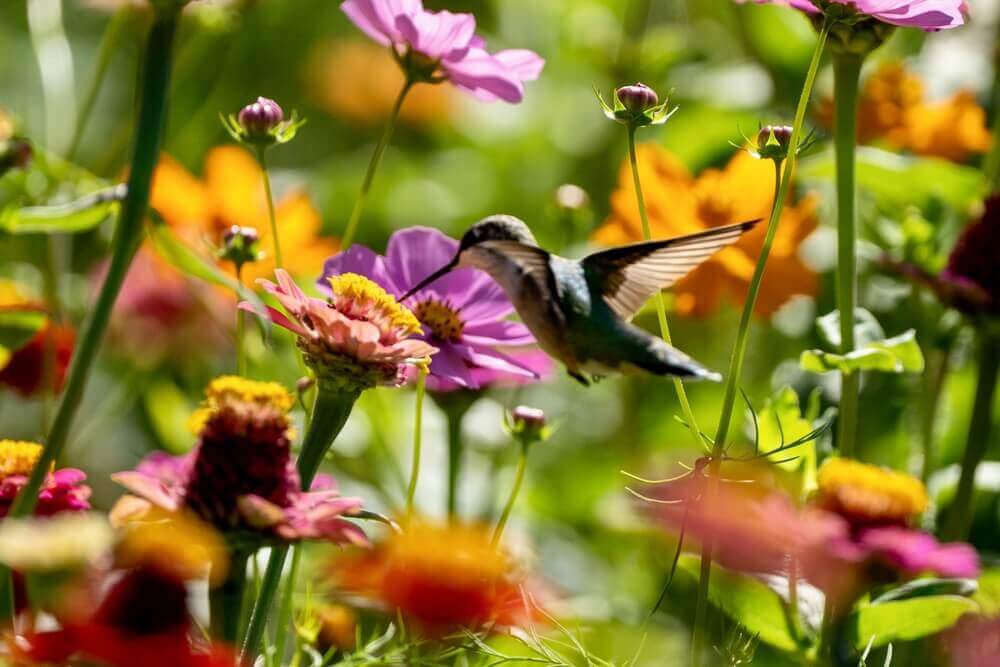
Hummingbird plants by bloom month: in the eastern United States, red buckeye, coral honeysuckle and crossvine feed ruby-throated hummingbirds as they arrive in March and April; columbine, fire pink and beebalm carry them through late spring; trumpet creeper and garden phlox fill midsummer; and cardinal flower, jewelweed and great blue lobelia fuel fall migration from August into October.
This guide turns that sequence into a month-by-month planting chart. It pairs 20 native nectar plants with the timing of the ruby-throated hummingbird (Archilochus colubris), the only hummingbird that breeds across eastern North America. Bloom months come from the USDA Forest Service, the Lady Bird Johnson Wildflower Center and university extension services, and migration dates come from the USA National Phenology Network. If you want a garden that has something in flower every week the birds are here, start with the chart below.
Why does bloom month matter for hummingbirds?
Bloom month matters because hummingbirds need nectar every day they are with us, and a garden that peaks in June and goes quiet in September misses the birds when they need fuel most. University of Missouri Extension notes that hummingbirds visit flowers five to eight times an hour and eat about half their body weight each day, so a steady chain of blooms keeps them coming back.
The USA National Phenology Network adds an important detail: spring migration overlaps with the flowering of some important nectar plants but not all of them, and birds reaching the northern edge of the range can arrive three to four weeks before any wildflowers open. Early-blooming shrubs, trees and vines bridge that gap. In fall, migration runs almost in step with jewelweed bloom, which is why late-season plants deserve as much space as summer favorites.
When do ruby-throated hummingbirds arrive and leave?
Ruby-throats reach the northern Gulf Coast as early as late February, with most arriving in March and early April, and nearly all have left the United States by mid-October. Arrival moves north through spring and departure starts in the north in early August.
| Region or milestone | Typical timing | Source |
|---|---|---|
| Northern Gulf Coast, first arrivals | Late February; most in March and early April | USA-NPN |
| Mississippi | March, as red buckeye and native azaleas bloom | Mississippi State University Extension |
| Missouri | Early to mid-April; peaks in early May and mid- to late September | University of Missouri Extension |
| Midwest, peak spring arrival | Mid-April | USA-NPN |
| Great Lakes, peak spring arrival | Early May | USA-NPN |
| Northeastern states, peak spring arrival | Mid-May | USA-NPN |
| Canada, first males | Late May | USDA Forest Service |
| Fall migration begins (north) | Early August | USA-NPN |
| Alabama, peak fall passage | Mid-August to early September | USA-NPN |
| Nearly all birds gone from the U.S. | Mid-October | USDA Forest Service |
The Forest Service guide describes the trip itself: most ruby-throats cross the Gulf of Mexico in a flight of roughly 500 miles that takes 18 to 22 hours. Birds bulk up for it, and the National Phenology Network notes that some nearly double their body mass in fat before they leave.
What are the best native hummingbird plants by bloom month?
The best plan uses a mix of trees, shrubs, vines and perennials whose bloom windows overlap from March to October. The master chart lists 20 native plants in the order they start flowering. Months are typical ranges from the cited source; in the Deep South expect the early end, and in the North and at higher elevations expect the later end.
| Plant | Botanical name | Type | Bloom months | Light and moisture | Source |
|---|---|---|---|---|---|
| Red buckeye | Aesculus pavia | Small tree | Mar–May | Part shade; moist, well-drained | USDA Forest Service |
| Coral honeysuckle | Lonicera sempervirens | Vine | Mar–Jun | Sun to part shade; well-drained | USDA Forest Service; Wildflower Center |
| Crossvine | Bignonia capreolata | Vine | Mar–May | Sun to part shade; moist, well-drained | USDA Forest Service |
| Indian pink | Spigelia marilandica | Perennial | Mar–May | Part shade; rich woodland soil | Wildflower Center |
| Virginia bluebells | Mertensia virginica | Perennial | Mar–Jun | Shade to part shade; moist, rich | USDA Forest Service |
| Lyreleaf sage | Salvia lyrata | Perennial | Mar–Jun | Sun to shade; adaptable | Wildflower Center |
| Eastern red columbine | Aquilegia canadensis | Perennial | Apr–Jul | Part shade to shade; well-drained | USDA Forest Service |
| Fire pink | Silene virginica | Perennial | Apr–Aug | Part shade; rocky, well-drained | USDA Forest Service |
| Flame azalea | Rhododendron calendulaceum | Shrub | May–Jun | Part shade; acidic, well-drained | USDA Forest Service |
| Butterfly weed | Asclepias tuberosa | Perennial | May–Jul | Sun to part shade; dry | USDA Forest Service |
| Scarlet beebalm | Monarda didyma | Perennial | May–Oct | Sun to part shade; rich, moist | Wildflower Center; USDA Forest Service |
| Wild bergamot | Monarda fistulosa | Perennial | May–Sep | Sun to part shade; adaptable | USDA Forest Service |
| Garden phlox | Phlox paniculata | Perennial | Jun–Aug | Full sun; moist loam | Wildflower Center |
| Trumpet creeper | Campsis radicans | Vine | Jul–Sep | Sun to part shade; moist, well-drained | USDA Forest Service |
| Rose mallow | Hibiscus moscheutos | Perennial | Jul–Sep | Sun to part shade; moist | USDA Forest Service |
| Dense blazing star | Liatris spicata | Perennial | Jul–Sep | Full sun; moist | Wildflower Center |
| Cardinal flower | Lobelia cardinalis | Perennial | May–Oct (peak late summer) | Sun to shade; moist to wet | Wildflower Center |
| Great blue lobelia | Lobelia siphilitica | Perennial | Jul–Oct | Part shade; moist to wet | Wildflower Center |
| Jewelweed | Impatiens capensis | Annual | Jul–Oct | Shade; moist to wet | Wildflower Center |
| Obedient plant | Physostegia virginiana | Perennial | Aug–Nov | Sun to shade; moist, rich | USDA Forest Service |
What is blooming for hummingbirds each month?
Every month from March through October has at least five plants from this list in flower, and May has the most. This view is built directly from the master chart, so you can spot a thin month in your own yard and fill it.
| Month | Native plants in bloom | What hummingbirds are doing |
|---|---|---|
| March | Red buckeye, coral honeysuckle, crossvine, Indian pink, Virginia bluebells, lyreleaf sage | Arriving along the Gulf Coast and in the Deep South |
| April | March plants plus eastern red columbine and fire pink | Moving north; peak arrival in the Midwest |
| May | Red buckeye, coral honeysuckle, crossvine, Indian pink, Virginia bluebells, lyreleaf sage, columbine, fire pink, flame azalea, butterfly weed, scarlet beebalm, wild bergamot, cardinal flower | Peak arrival in the Great Lakes and Northeast; nesting begins |
| June | Coral honeysuckle, Virginia bluebells, lyreleaf sage, columbine, fire pink, flame azalea, butterfly weed, scarlet beebalm, wild bergamot, garden phlox, cardinal flower | Nesting and raising young |
| July | Columbine, fire pink, butterfly weed, scarlet beebalm, wild bergamot, garden phlox, trumpet creeper, rose mallow, dense blazing star, cardinal flower, great blue lobelia, jewelweed | Second broods in many areas; young birds on the wing |
| August | Fire pink, scarlet beebalm, wild bergamot, garden phlox, trumpet creeper, rose mallow, dense blazing star, cardinal flower, great blue lobelia, jewelweed, obedient plant | Fall migration begins in the north |
| September | Scarlet beebalm, wild bergamot, trumpet creeper, rose mallow, dense blazing star, cardinal flower, great blue lobelia, jewelweed, obedient plant | Peak fall passage across the South |
| October | Scarlet beebalm, cardinal flower, great blue lobelia, jewelweed, obedient plant | Last migrants pass through; most gone by mid-month |
| November | Obedient plant | Ruby-throats have left for Mexico and Central America |
Which plants feed hummingbirds first in spring?
Red buckeye, coral honeysuckle, crossvine and red columbine are the first-course plants. Mississippi State University Extension reports that hummingbirds reach Mississippi in March just as red buckeye and native azaleas flower, and that the birds are said to follow those blooms north.
Red buckeye is a natural fit for a woodland edge, and we grow it here because it opens its red tubular flowers right when the first males show up. Pair it with Indian pink in part shade, add coral honeysuckle or crossvine on a fence, and tuck lyreleaf sage into sunny or shady gaps for a low layer of spring nectar. Our native tree and shrub bloom calendar shows more woody plants that flower early.
What should bloom for hummingbirds in summer?
Summer is the season of beebalm, phlox, trumpet creeper and rose mallow. These plants carry nesting females, which also hunt small insects to feed their young; Missouri Extension notes that a female can eat up to 2,000 insects a day.
The Forest Service describes scarlet beebalm as pollinated mainly by ruby-throated hummingbirds and butterflies, so a patch of bee balm is one of the strongest summer anchors you can plant. Garden phlox and blazing star add height in a sunny border, while trumpet vine covers an arbor or fence with orange trumpets from July into September. For more climbers, see climbing flowers for a trellis or browse our flowering vines.
Which plants help hummingbirds during fall migration?
Cardinal flower, jewelweed, great blue lobelia and obedient plant are the late-season fuel stations. The National Phenology Network notes that fall migration is almost synchronous with jewelweed bloom, and the Wildflower Center describes jewelweed as especially adapted to hummingbird visits.
These plants share a love of moist soil, so a rain garden, pond edge or low spot is the perfect home. Cardinal flower brings bright red spikes, great blue lobelia adds cool blue beside it, and rose mallow holds the back of the bed with dinner-plate flowers. Missouri Extension also suggests leaving feeders up through October for late migrants passing through.
What kind of flowers attract hummingbirds most?
Tubular flowers in red, orange or pink attract hummingbirds most, according to University of Missouri Extension, though the birds will feed from flowers of most colors. Missouri Extension also notes that about 150 plant species are pollinated by hummingbirds.
- Shape: long tubes that fit a hummingbird bill, like columbine spurs, cardinal flower and trumpet creeper.
- Color: red and orange stand out, but blue lobelia, purple blazing star and lavender lyreleaf sage are visited too.
- Layers: combine trees, shrubs, vines and perennials so flowers appear at different heights.
- Clusters: plant several of each species together; the Florida extension service notes that hummingbirds can be territorial, so more than one flower bed lets several birds feed at once.
- Natives first: the Forest Service and Missouri Extension both recommend native species adapted to your region.
For a ready-made start, our 10 Hummingbird Plants package sends a mix of perennials chosen for your zone, and the full hummingbird plants collection lets you pick by bloom season. Gardeners building a broader habitat will also like our pollinator plants and long-blooming perennials.
How do I plan a hummingbird garden that blooms all season?
Choose at least two plants for each season from the chart, match them to your light and soil, and place them where you can watch them. A small yard can cover March through October with six to eight species.
- Anchor spring with one woody plant (red buckeye or a native azalea) and one vine (coral honeysuckle or crossvine).
- Fill the gap with columbine, Indian pink or lyreleaf sage in part shade.
- Carry summer with scarlet beebalm and garden phlox in sun, plus trumpet creeper on a sturdy support.
- Fuel migration with cardinal flower and great blue lobelia in a moist spot.
- Add water and perches. The Forest Service notes that hummingbirds are drawn to moving water, and Missouri Extension recommends nearby trees and shrubs for resting cover.
For more design ideas, read how to attract hummingbirds to your garden and what plants attract hummingbirds. If you also want caterpillar food for butterflies in the same beds, our butterfly host plant chart pairs well with this guide, and native trees that feed birds in winter covers the months after the hummingbirds leave.
How we made this guide
We started with the plant table in the USDA Forest Service publication Maintaining and Improving Habitat for Hummingbirds in the Eastern United States and kept only species native to the eastern U.S. that gardeners can grow. We checked bloom months against the Lady Bird Johnson Wildflower Center plant database and used University of Missouri Extension and Mississippi State University Extension for flower traits and regional timing. Migration milestones come from the USA National Phenology Network species profile and the Forest Service guide. Where sources disagreed, we listed the range from the source named in the table.
TN Nursery is a family-owned, third-generation nursery in Altamont, Tennessee, founded in 1959 by Roscoe Tate. Over more than 65 years our growers have raised native plants on 170 acres and supplied plants to major U.S. landmarks like the Washington Monument and Arlington National Cemetery. Many of the plants in this chart grow in our own fields.
Reviewed by the TN Nursery growing team, November 24, 2026.
Share this guide
Teachers, bloggers, garden clubs, master gardener programs and conservation groups are welcome to use the bloom-month charts on this page in lessons, newsletters and handouts. Please credit TN Nursery and link back to this page: Hummingbird Plants by Bloom Month. A free printable infographic version is on the way.
Frequently asked questions
What is the first flower hummingbirds feed on in spring?
In the South, red buckeye and native azaleas are among the first, and Mississippi State University Extension notes that hummingbirds arrive as they bloom. Farther north, eastern red columbine flowers as returning ruby-throats pass through.
What should I plant for hummingbirds in late summer and fall?
Plant cardinal flower, great blue lobelia, jewelweed and obedient plant. They bloom from late summer into October, which matches fall migration from early August to mid-October.
When do hummingbirds leave the eastern United States?
Fall migration begins in early August in the north, and the USDA Forest Service reports that nearly all ruby-throated hummingbirds have left the U.S. by mid-October.
Do hummingbirds only visit red flowers?
No. Red, orange and pink tubular flowers are favorites, but hummingbirds feed from flowers of most colors, including blue lobelia and purple blazing star.
How many hummingbird plants do I need for a full season?
Six to eight species with overlapping bloom times can cover March through October. Choose at least two each for spring, summer and fall.
Sources
- USDA Forest Service: Maintaining and Improving Habitat for Hummingbirds in the Eastern United States
- USA National Phenology Network: Ruby-throated Hummingbird
- University of Missouri Extension: Attracting Hummingbirds to Your Property (G9419)
- Mississippi State University Extension: Attracting Hummingbirds to Mississippi Gardens
- University of Florida IFAS Extension: Hummingbirds of Florida
- Lady Bird Johnson Wildflower Center: Lonicera sempervirens
- Lady Bird Johnson Wildflower Center: Spigelia marilandica
- Lady Bird Johnson Wildflower Center: Salvia lyrata
- Lady Bird Johnson Wildflower Center: Monarda didyma
- Lady Bird Johnson Wildflower Center: Phlox paniculata
- Lady Bird Johnson Wildflower Center: Liatris spicata
- Lady Bird Johnson Wildflower Center: Lobelia cardinalis
- Lady Bird Johnson Wildflower Center: Lobelia siphilitica
- Lady Bird Johnson Wildflower Center: Impatiens capensis


