
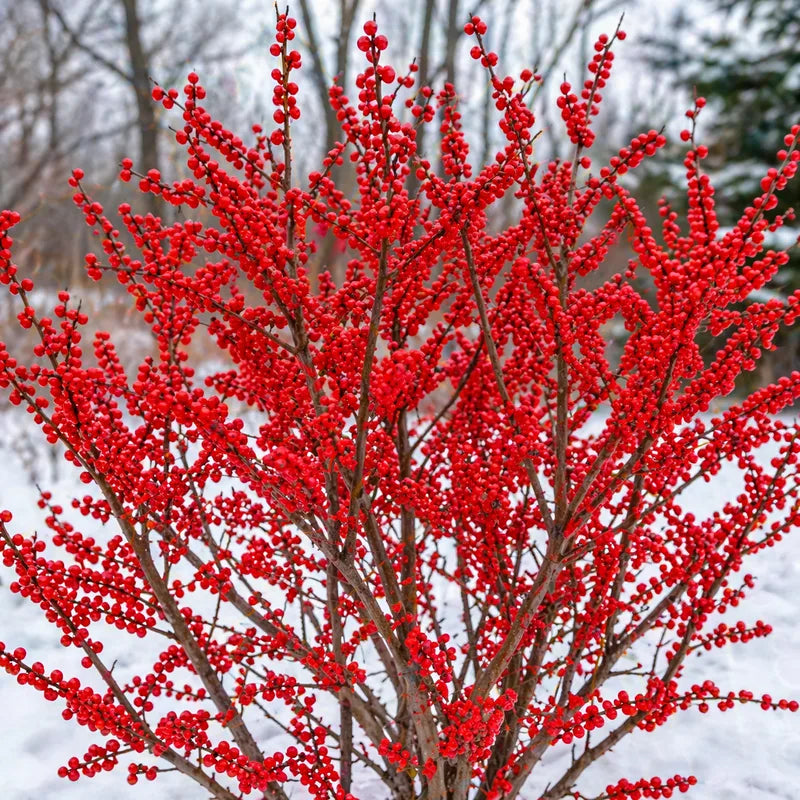
Why does a winterberry holly have no berries? Almost always because there is no male plant close enough to pollinate it. Winterberry (Ilex verticillata) grows male and female flowers on separate shrubs, and only the females carry the red fruit. A female needs a male of the same species that blooms at the same time, planted within about 40 to 50 feet. Get that pairing right, plant in moist, acidic soil with decent sun, and this native shrub will hold bright red berries from fall well into winter.
November is when winterberry earns its place. Its leaves drop, and bare stems covered in red fruit stand out against gray woods and snow. It is also a good month to plant here in Tennessee, since cool air and warm soil let roots settle in before spring. The Clemson Cooperative Extension lists winterberry as hardy in zones 3 to 9, growing about 6 to 12 feet tall with a similar spread. Our Winterberry Holly is the native eastern species.
Winterberry and its winter partners
Why winterberry has no berries: 5 causes and fixes
1. No male plant nearby
This is the cause in most yards. Male winterberry shrubs never make fruit, and females make little or none without pollen. Bees carry pollen from the male flowers to the females in late spring. Clemson's guidance is about 1 male for every 4 to 5 females when plants are spread out. When they are within roughly 40 feet, a single male can serve up to 20 females. NC State Extension gives a similar rule: one male for 10 to 20 females within 50 feet.
Fix: Unless a plant is sold as a named male or female variety, you won't know its sex until it flowers. Plant winterberry in a group of 3 to 5 so you are very likely to end up with both.
2. The male blooms at the wrong time
A male and a female that bloom weeks apart will not set fruit, even side by side. Named varieties are sold in matched pairs for this reason. NC State Extension lists 'Jim Dandy' as an early-blooming male and 'Southern Gentleman' as a late-blooming one. Each pairs with females that flower at the same time.
Fix: Match bloom times when buying named varieties. With unnamed native plants grown in a group, bloom times usually overlap enough on their own.
3. The shrub is still young
Young shrubs put their first years into roots and stems. A newly planted winterberry may flower lightly or not at all for a season or two, and fruit follows the flowers.
Fix: Give it time. Water deeply once a week in dry spells through the first summer, and keep a 2- to 3-inch ring of mulch over the roots, pulled back from the stems.
4. It was pruned at the wrong time
Winterberry flowers on new growth, so the timing of a cut decides next year's fruit. Heavy pruning after new shoots start in spring removes the wood that would have flowered.
Fix: Prune early in the season, before new growth appears. Cutting berry-covered branches for holiday arrangements in December counts as pruning too, so spread your cuts across the shrub.
5. Wrong soil or too much shade
Winterberry wants acidic soil. NC State puts the target pH below 6.0 and notes that neutral to alkaline soil can turn leaves yellow, a sign called chlorosis. It tolerates part shade, but more sun usually means more flowers and more fruit.
Fix: Test your soil through your county Extension office before planting. Choose a spot with at least a half day of sun.
How to plant winterberry holly
Plant any time the ground isn't frozen. Fall and early winter work well across most of Tennessee. Winterberry is one of the few shrubs that handles wet feet: in the wild it grows along streams, pond edges and swamps. That makes it a strong choice for a low spot, a rain garden or a soggy corner where other shrubs fail.
- Soak bare roots in a bucket of water for 1 to 2 hours before planting.
- Dig a hole twice as wide as the roots and just as deep.
- Set the crown at soil level, backfill with the native soil, and firm it gently.
- Water deeply, then mulch 2 to 3 inches deep, keeping mulch off the stems.
- Space plants about 3 to 5 feet apart for a mass planting or hedge, closer for a quick screen.
If cold snaps worry you, our guide on protecting plants from winter freeze damage covers mulching and watering before a hard frost.
Shrubs that pair well with winterberry
Winterberry looks best with plants that share its taste for moist soil and add their own winter interest. Red osier dogwood brings bright red stems once its leaves fall. Spicebush is another native with red fruit and yellow early-spring flowers; like winterberry, it has separate male and female plants. Chokeberry holds its fruit into winter and colors well in fall. For a taller backdrop, arrowwood and blackhaw viburnum both feed birds and tolerate a range of soils. See our blackhaw viburnum growth guide for how quickly that one fills in.
For wildlife: More than 48 bird species use winterberry for cover, nesting or winter food, including cedar waxwings. Birds often leave the fruit until late winter, when other food runs short, which is why the berries last so long on the branch. It is also a host plant for the Henry's elfin butterfly. For more native plants that feed insects and birds, see how to plant a pollinator garden that blooms until frost.
Frequently asked questions
Is winterberry holly poisonous to dogs and people?
The berries and leaves contain saponins and are considered mildly toxic. Eating them can cause vomiting or diarrhea in people and pets, so keep curious dogs and small children from snacking on fallen fruit. The plant does not irritate skin.
Does winterberry holly stay green in winter?
No. Winterberry is a deciduous holly, so it drops its leaves in fall. That is what makes the red berries so visible on bare stems. If you want an evergreen holly, see our guide to American holly.
How fast does winterberry grow?
Winterberry is a slow to moderate grower. It spreads slowly by suckers into a multi-stemmed clump and reaches about 6 to 12 feet tall and wide at maturity, depending on the site and variety.
Can winterberry grow in wet soil?
Yes. It prefers soil that stays consistently moist and tolerates periodic flooding, which makes it one of the best native shrubs for rain gardens, pond edges and poorly drained yards.
Keep reading
