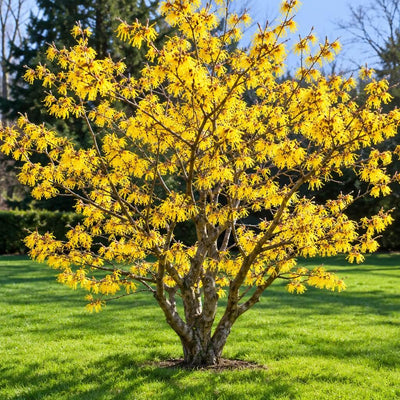
Quick answer: A shrub is a woody perennial plant with several stems rising from at or near the ground, none of them dominant, that usually stays under about 10 to 13 feet tall. A tree typically has one main trunk and grows taller. "Bush" is an everyday word for a shrub, especially a dense, much-branched one.
Shrubs do most of the work in a home landscape. They make hedges and privacy screens, fill foundation beds, bloom in spring, feed birds with berries and give structure in winter. Knowing what counts as a shrub, and how shrubs differ from trees, helps you choose the right plant and give it the right space. TN Nursery has grown shrubs on our Tennessee farm since 1959, and this guide draws on extension, conservation and botanical sources.
Quick facts: shrubs
| Definition | Woody perennial plant with several stems from the base, none dominant |
| Typical height | Usually under 10 to 13 ft; some reach 20 ft |
| Stems | Multiple, usually under about 3 inches thick at chest height |
| Types | Deciduous or evergreen; flowering, berry-producing, hedge and ground-cover forms |
| Lifespan | Perennial; woody stems live for many years |
| Best planting time | Fall or early spring, while plants are dormant |
| Spacing | About half the mature width apart for a hedge; full mature width for single plants |
| Native examples | American hazelnut, spicebush, witch hazel, buttonbush, arrowwood viburnum, Carolina allspice |
What is a shrub?
A shrub is a woody plant with several perennial stems, none of which dominates. Britannica describes it as usually less than 3 meters (about 10 feet) tall. The Missouri Department of Conservation defines shrubs as woody plants under 13 feet that usually have multiple stems, generally less than 3 inches in diameter at breast height. "Woody" means the stems build lasting wood from cellulose and lignin, so they survive winter above ground instead of dying back like a perennial flower.
What is the difference between a shrub and a tree?
A tree usually has one main trunk and grows taller, while a shrub has several stems from the base and stays lower.
- Trunk: trees typically have a single erect trunk; shrubs have several stems from near the soil line.
- Height: Missouri Conservation uses 13 feet as the dividing line. Utah State University Extension describes a tree as reaching at least 13 feet with a trunk at least 3 inches thick at 4.5 feet above the ground. The National Park Service uses a looser 20-foot guideline.
- Crown: trees form a defined crown of branches above the trunk; shrubs are usually leafy from the ground up.
These lines are fuzzy. Utah State notes that no scientific definition separates trees and shrubs, and many plants are "tree-like shrubs" or "shrub-like trees." Witch hazel, American hazelnut and lilac can be grown as multi-stemmed shrubs or pruned to a single trunk like small trees. Birdwatcher David Sibley offered a handy rule of thumb: if you can walk under it, it's a tree; if you have to walk around it, it's a shrub.
Is a bush the same as a shrub?
Yes, for practical purposes. "Bush" is not a separate botanical category. Britannica notes that a shrub that is much-branched and dense may be called a bush. Gardeners tend to say "bush" for rounded, compact plants (a boxwood bush, a blueberry bush) and "shrub" in planting plans, but they mean the same kind of plant.
What is the difference between a shrub and a vine or perennial?
A vine has stems that cannot hold themselves up, so it climbs or sprawls using tendrils or twining stems. A perennial flower such as a coneflower or daylily is herbaceous: its soft stems die back to the ground each winter and regrow from the roots. A shrub keeps its woody stems above ground year after year. Some plants, called subshrubs, are woody only at the base.
What are the main types of shrubs?
Shrubs are usually grouped by leaf habit and by what they do in the landscape:
- Deciduous shrubs drop their leaves in fall. Many have spring flowers, fall color or berries, such as arrowwood viburnum and spicebush.
- Evergreen shrubs keep their foliage all year. Boxwood and junipers are common choices for hedges and winter structure. See our evergreen shrubs and our juniper growing guide.
- Flowering shrubs are grown mainly for blooms, from fragrant Carolina allspice to winter-blooming witch hazel. Browse flowering shrubs.
- Berry and wildlife shrubs feed birds and pollinators, such as elderberry, buttonbush and hazelnut. See shrubs with berries.
- Hedge and privacy shrubs are dense plants you can plant in a row for screening. See privacy shrubs.
What are some examples of native shrubs?
Native shrubs are adapted to local soils and support local wildlife. Good choices for the eastern United States include:
- American hazelnut (Corylus americana): edible nuts and a natural hedge. Read our hazelnut tree guide.
- Witch hazel (Hamamelis virginiana): yellow flowers in fall and winter. See our witch hazel plant guide.
- Spicebush (Lindera benzoin): early yellow flowers and red berries for shade.
- Buttonbush (Cephalanthus occidentalis): round white blooms for wet soil and rain gardens.
- Arrowwood viburnum (Viburnum dentatum): white flower clusters and blue berries.
- Carolina allspice (Calycanthus floridus): fragrant maroon flowers.
Some popular non-native shrubs, such as burning bush, are invasive in parts of the U.S. Our post on burning bush vs. firebush covers native alternatives. Not sure what fits your yard? Try our free plant finder.
How do you choose and plant a shrub?
Match the shrub's mature size, light and soil needs to the spot, then plant it while it is dormant.
- Check the mature size. Read the label for height and width, and leave room so you are not pruning constantly.
- Match light and soil. Spicebush and witch hazel take shade; buttonbush likes wet ground; most flowering shrubs bloom best in sun.
- Plant in fall or early spring. Dig a hole about twice as wide as the roots and no deeper than the root system. Set the plant at the depth it grew, backfill with native soil and water deeply. Our guide on how to plant bare-root plants walks through each step.
- Space for the purpose. For a hedge, plant closer, about half the mature width apart. Our tree and shrub calculator works out how many plants you need.
- Mulch and water. Add 2 to 3 inches of mulch, kept off the stems, and water weekly through the first growing season.
Frequently asked questions
What is a shrub in simple terms?
A shrub is a woody plant with several stems growing from the base, usually under about 10 to 13 feet tall, that keeps its stems above ground year after year.
What is the difference between a shrub and a bush?
There is no botanical difference. Bush is an everyday word for a shrub, usually one that is dense and much-branched.
How tall can a shrub get?
Most shrubs stay under 10 to 13 feet, but some large shrubs reach 15 to 20 feet in good conditions.
Can a shrub become a tree?
Some can be trained that way. Large shrubs such as witch hazel, hazelnut and lilac can be pruned to one trunk and grown as small trees.
Is a shrub a perennial?
Yes. Shrubs are woody perennials. Unlike herbaceous perennials, their stems do not die back to the ground in winter.
When is the best time to plant shrubs?
Fall and early spring, while shrubs are dormant, are the best times. Cool weather lets roots establish before summer heat.
Are boxwoods shrubs?
Yes. Boxwood is an evergreen shrub widely used for hedges and foundation plantings.
What is a native shrub?
A native shrub is one that grew naturally in a region before European settlement, such as spicebush, witch hazel or American hazelnut in the eastern United States.
Shop popular shrubs


Find more in our full shrubs collection, native shrubs and shrubs for shade. TN Nursery was founded in 1959 by Roscoe Tate and grows on 170 acres in Tennessee.