
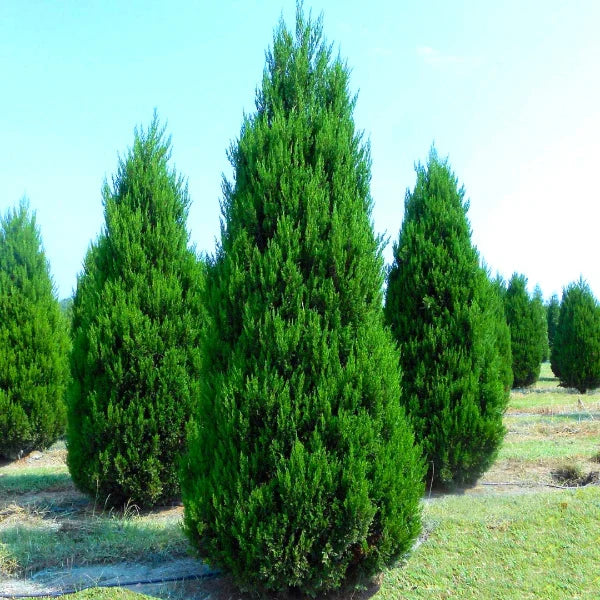
Quick answer: Junipers grow best in full sun and well-drained soil, and they tolerate drought, heat, poor soil and both acid and alkaline pH once established. Eastern red cedar (Juniperus virginiana), the native juniper of the eastern U.S., is hardy in zones 3 to 9 and grows 30 to 40 feet tall. Plant it while dormant and avoid wet sites.
Quick facts
| Botanical name | Juniperus virginiana (eastern red cedar, a juniper) |
|---|---|
| USDA zones | 3–9 (NC State lists 2–9) |
| Sun | Full sun; tolerates shade only when very young |
| Soil | Almost any well-drained soil: clay, loam, sand, rocky; not continuously wet |
| Soil pH | Acid to alkaline |
| Water | Water weekly in dry spells the first year; very drought tolerant once established |
| Mature size | Usually 30–40 ft tall, 10–20 ft wide; can reach 60 ft |
| Spacing | 12–24 ft apart (closer end for screens and windbreaks) |
| Cones ("berries") | Blue, waxy, about 1/4 in., on female trees; eaten by cedar waxwings and other birds |
| Best planting time | Fall through early spring while dormant |
| Native range | Maine to Florida, west to South Dakota and Texas |
"Juniper" covers a big family of evergreens, from low groundcovers to 60-foot trees. Thirteen species are native to North America, according to Clemson Extension. In the eastern U.S., the one you see along fencerows and old fields is eastern red cedar. Despite the name, it is a juniper, not a true cedar. This guide focuses on growing eastern red cedar, with notes that apply to most landscape junipers. Need to know your zone first? Try our free find my planting zone tool.
Is eastern red cedar a juniper?
Yes. Eastern red cedar is Juniperus virginiana, a juniper. Virginia Tech Extension calls "eastern redcedar" a misnomer, since the species is not a true cedar.
Early settlers called it cedar because of its fragrant, reddish heartwood. The cedar tree TN Nursery grows is this native eastern red cedar.
Where do junipers grow best?
Junipers grow best in full sun and well-drained soil. They handle heat, drought, wind, salt and poor soil better than most evergreens.
- Sun: Full sun. NC State Extension says eastern red cedar tolerates shade only when it is very young. In shade, junipers thin out and lose lower branches.
- Soil: Virginia Tech says it grows in any soil type except poorly drained, from acid to somewhat alkaline. NC State lists clay, loam, sand and shallow rocky soil, and notes it prefers some moisture but will not tolerate continuously wet soil.
- Zones: Virginia Tech gives zones 3 to 9; NC State lists 2 through 9.
- Toughness: NC State says eastern red cedar has the best drought resistance of any conifer native to the eastern U.S., is highly salt tolerant, and resists deer damage.
When should you plant a juniper?
Plant junipers from fall through early spring while they are dormant. Fall planting lets roots grow in cool, moist soil before summer.
Bare-root and field-dug evergreens should go in during the dormant season. Container-grown junipers are more flexible, but planting in the heat of summer means you will need to water much more often. Avoid planting into frozen or waterlogged ground.
How do you plant a juniper?
Plant a juniper in a wide hole at the same depth it grew, in a sunny, well-drained spot, then water deeply and mulch.
- Pick a spot with room. Eastern red cedar grows 30 to 40 feet tall and 10 to 20 feet wide in good conditions (NC State), so keep it clear of power lines and buildings.
- Dig wide. Make the hole two to three times as wide as the root mass and no deeper.
- Set the depth. The top of the root ball or the old soil line on a bare-root plant should sit level with the ground. Our bare-root planting guide shows how to soak and spread the roots.
- Backfill and firm. Use the native soil; junipers do not need rich amendments.
- Water deeply right after planting.
- Mulch 2 to 3 inches deep in a ring, keeping it a few inches from the trunk.
How far apart should you plant junipers for privacy?
Space eastern red cedars 12 to 24 feet apart, the range NC State Extension gives. Use the closer end of that range for a dense screen or windbreak.
Clemson Extension adds that junipers should be spaced for their mature height and spread, because good air movement helps prevent disease. For a longer windbreak, stagger two rows so the trees in the second row fill the gaps in the first. Our tree and shrub calculator works out how many trees you need for a given length of fence line. For more screening ideas, see the best privacy trees for fencerows.
How often should you water a juniper?
Water a new juniper deeply about once a week during dry weather for its first growing season. After that, it rarely needs extra water.
Overwatering is a bigger risk than drought. Junipers in soggy soil suffer root problems, so let the soil dry between waterings and never plant where water stands after rain.
How do you prune a juniper?
Prune junipers lightly and only into green, leafy growth. Virginia Tech notes eastern red cedar is very tolerant of pruning, but you should not cut into wood without foliage.
Bare interior wood on a juniper usually does not sprout new growth, so a hard cut leaves a permanent hole. Shape the tree a little each year instead of making big cuts. Our older guide on how to trim juniper shrubs walks through shearing and thinning.
Do junipers have berries?
Female junipers produce small, berry-like cones. On eastern red cedar they are blue, frosted-looking and about 1/4 inch across (NC State).
Eastern red cedar has separate male and female trees. Male trees carry small yellow-brown pollen cones at the branch tips. The female "berries" are fleshy cones made of fused scales; NC State says they are beloved by cedar waxwings, and songbirds and small mammals eat them through winter. The dense foliage also gives birds shelter and nesting sites.
What pests and diseases affect junipers?
The main problems are cedar-apple rust, bagworms and tip blights. Most are minor on eastern red cedar planted in full sun with good air flow.
- Cedar-apple rust: eastern red cedar is an alternate host for this fungus. Virginia Tech says it has only a minor effect on the cedar, but it damages apple leaves and fruit, so do not plant red cedar near apple trees. Clemson also lists quince and hawthorn rusts.
- Bagworms: both Clemson and NC State list them. Hand-pick the spindle-shaped bags in winter before eggs hatch in spring.
- Tip blights: Clemson lists Phomopsis, Cercospora and Kabatina tip blights on junipers in the Southeast. Wide spacing and full sun reduce them.
- Mites and scale: NC State notes mites and scale may occur, usually on stressed plants.
Is eastern red cedar invasive?
It is native to the eastern U.S., but it can spread aggressively into open land. Virginia Tech calls it a pioneer species that quickly populates farm fields because birds spread its seeds, and many gardeners consider it weedy.
Plant it responsibly: keep it in maintained landscapes, windbreaks and screens, and pull volunteer seedlings where you do not want them, especially near pastures and open fields. In a mixed planting, pairing it with other natives such as American arborvitae or white pine adds variety. Browse more in our evergreen trees collection.
What other junipers can you grow?
Clemson Extension lists several landscape junipers: Chinese juniper and its cultivars, Pfitzer-type spreading junipers (6 to 12 feet tall), southern red cedar (J. virginiana var. silicicola, native from coastal North Carolina to Florida and the Gulf Coast), and Rocky Mountain juniper, which Clemson notes is less suited to humid climates and more disease-prone than eastern red cedar. In the humid East, eastern red cedar is the toughest choice.
Frequently asked questions
How fast do junipers grow?
Eastern red cedar grows at a medium rate, according to NC State Extension. Growth is fastest in full sun with some moisture and slows on dry, rocky ground.
Do junipers need full sun?
Yes. Junipers need full sun. Eastern red cedar tolerates shade only when very young, and junipers in shade become thin and leggy.
What is the best soil for junipers?
Any well-drained soil, including clay, loam, sand and rocky ground, with a pH from acid to alkaline. Avoid soil that stays wet.
How tall does an eastern red cedar get?
Usually 30 to 40 feet tall and 10 to 20 feet wide in good conditions, and occasionally up to 60 feet.
How far apart should you plant red cedars for a windbreak?
NC State Extension recommends 12 to 24 feet apart. Use the closer spacing, or two staggered rows, for a denser screen.
Can you cut a juniper back hard?
No. Junipers usually do not regrow from bare wood, so prune only into green, leafy growth and shape the plant a little each year.
Should you plant red cedar near apple trees?
No. Eastern red cedar is an alternate host for cedar-apple rust, which harms apple leaves and fruit, so keep the two apart.
Are juniper berries eaten by birds?
Yes. The blue cones on female eastern red cedars are eaten by cedar waxwings, other songbirds and small mammals in fall and winter.
Shop junipers and evergreen screening trees


TN Nursery has grown native trees on our Tennessee farm since Roscoe Tate founded it in 1959. Give an eastern red cedar sun, drainage and room, and it will screen your yard and feed winter birds for generations.


