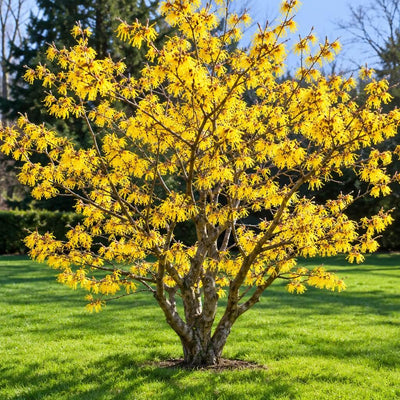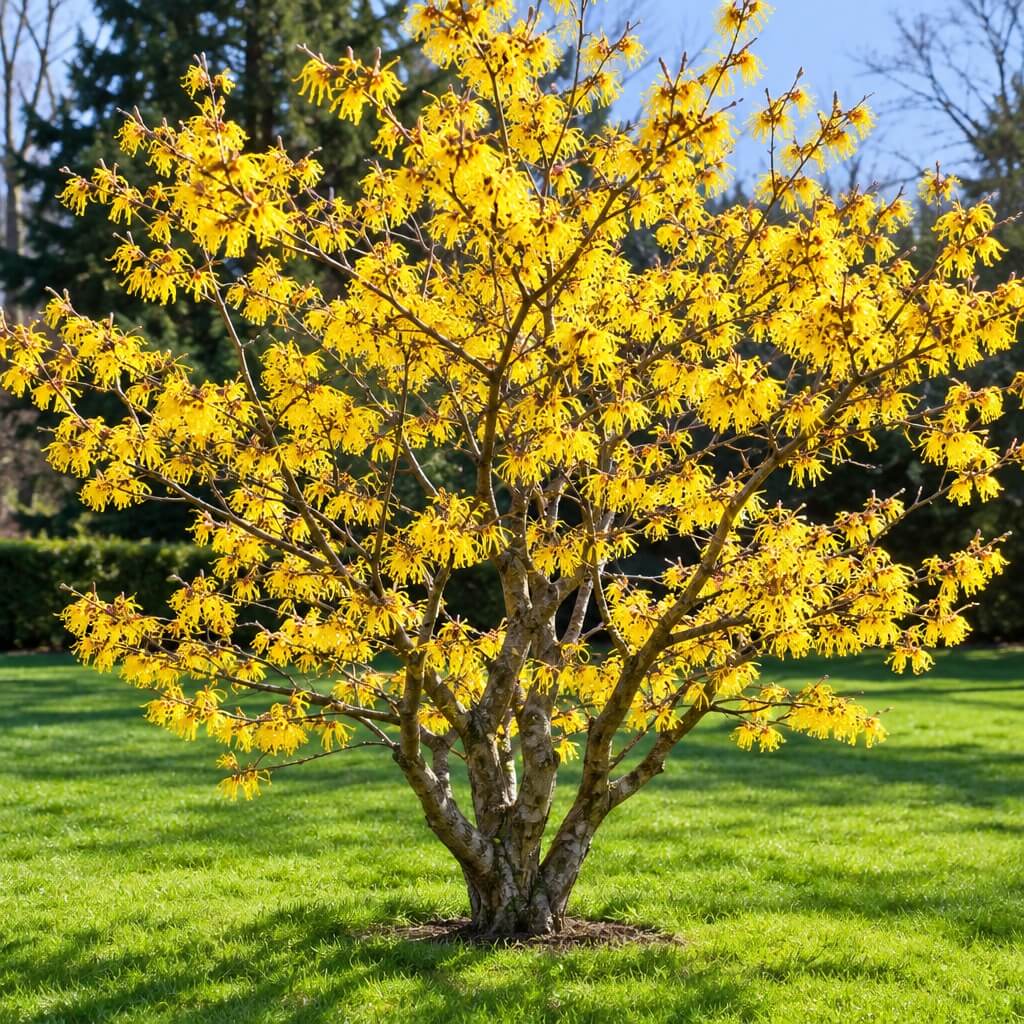
Quick answer: Witch hazel is a native North American shrub or small tree (Hamamelis virginiana) that blooms with fragrant, spidery yellow flowers from about October to December, often after its leaves drop. It grows 15 to 30 feet tall in USDA zones 3 to 9, in part shade to full sun and moist, slightly acidic soil.
Quick facts
| Botanical name | Hamamelis virginiana (common witch hazel) |
|---|---|
| USDA zones | 3–9 |
| Sun | Part shade to full sun (more sun = more flowers) |
| Soil | Moist, humus-rich, well-drained; tolerates clay |
| Soil pH | Acidic to slightly acidic (below about 6.8) |
| Water | Even moisture; water regularly until established |
| Mature size | Usually 15–20 ft tall as a shrub; up to 30 ft as a small tree; 15–20 ft wide |
| Spacing | Allow 12–20 ft per plant |
| Bloom time | October–December (yellow, fragrant, 4 strap-like petals) |
| Best planting time | Fall or early spring while dormant |
| Native range | Nova Scotia and Quebec south to Florida, west to Minnesota and Texas |
If you searched for "witch hazel," you may have meant the bottle in your medicine cabinet. That extract comes from a real plant: a tough, native shrub that flowers when almost nothing else in the yard does. This guide covers what the plant is, when it blooms, and how to plant and care for it. Need your zone first? Use our free planting zone calculator.
What is witch hazel?
Witch hazel is a deciduous shrub or small multi-stemmed tree in the genus Hamamelis. The species most Americans know is common witch hazel, Hamamelis virginiana, which grows wild in woodland understories across the eastern half of North America.
It has oval, wavy-edged leaves that turn yellow in fall. Its flowers have four thin, crinkled, ribbon-like yellow petals, each about half to three-quarters of an inch long, and they carry a light, spicy fragrance. TN Nursery grows and ships common witch hazel plants and bare-root witch hazel seedlings.
When does witch hazel bloom?
Common witch hazel blooms in fall, usually from October into December, often as its leaves are dropping. Its close cousin, vernal witch hazel (Hamamelis vernalis), blooms in late winter, roughly January to early March.
The U.S. Forest Service notes that common witch hazel flowers are pollinated by moths, which are among the few insects still active on mild late-fall days. That late bloom is a large part of why gardeners plant it: it gives color and fragrance after most flowers are long gone.
Is witch hazel a tree or a shrub?
Both. Common witch hazel usually grows as a large, multi-stemmed shrub 12 to 20 feet tall, but in good conditions it can become a small tree 20 to 30 feet tall and 15 to 20 feet wide. Vernal witch hazel stays smaller, about 6 to 16 feet.
Where does witch hazel grow best?
Witch hazel grows best in moist, rich, slightly acidic soil with part shade to full sun. It is hardy in USDA zones 3 through 9, so it suits most of the eastern and central U.S.
- Light: It tolerates shade, but NC State Extension and Clemson HGIC both note that it flowers best with more sun. In hot southern summers, a spot with afternoon shade or a north- or east-facing exposure keeps leaves from scorching.
- Soil: Moist, humus-rich and well drained is ideal. It tolerates clay and brief wet spells, but it does not like long droughts.
- Uses: Woodland edges, naturalized borders, under tall shade trees, and as an informal screen. See more options in our shrubs for shade collection.
How do you plant witch hazel?
Plant witch hazel in fall or early spring while it is dormant, in a hole as deep as the root system and two to three times as wide. Water deeply and mulch.
- Pick the spot. Give it 12 to 20 feet of room to spread, with at least a few hours of sun for good flowering.
- Dig wide, not deep. Set the plant so the root flare (or the old soil line on a bare-root seedling) sits at or slightly above grade.
- Backfill with native soil. Break up clods and firm the soil gently to remove air pockets. Heavy amendments are not needed in decent soil.
- Water deeply. Soak the root zone right after planting.
- Mulch. Spread 2 to 3 inches of shredded bark or leaf mulch in a wide ring, keeping it a few inches off the stems.
Planting bare-root seedlings? Our step-by-step bare-root planting guide walks through soaking and setting the roots.
How do you care for witch hazel?
Witch hazel is low-maintenance once established. Keep it watered the first year or two, mulch the roots, and prune only to shape it or remove suckers.
- Water: The Forest Service notes it needs regular watering while it establishes. Afterward, water during long dry spells, since it is not very drought tolerant.
- Fertilizer: Usually unnecessary in reasonably fertile soil. A layer of leaf mulch or compost each year is enough.
- Pruning: NC State Extension says pruning is not usually needed except to keep its shape. Common witch hazel tends to sucker, so remove unwanted shoots at the base. The University of Maryland Extension notes that established plants tolerate heavy rejuvenation pruning or thinning of the oldest stems. Prune right after flowering or in early spring.
- Pests: It has no serious pest problems. Small cone-shaped or spiny galls on the leaves are made by aphids and, per Maryland Extension, do not harm the plant and need no treatment.
How fast does witch hazel grow?
Witch hazel grows at a slow to moderate rate. Plants grown from seed usually take several years to flower; the Forest Service says seedlings typically do not bloom until they are at least six years old, so a larger nursery-grown plant gets you flowers sooner.
How does witch hazel spread its seeds?
Witch hazel launches its seeds. After flowering, the fruit develops for most of the next year into a woody, two-part capsule. When it dries and splits, it forcibly shoots out two shiny black seeds. The Forest Service reports distances of 10 to 20 feet and rarely up to 40 feet; the Lady Bird Johnson Wildflower Center cites up to about 30 feet. You can sometimes hear the capsules pop on a dry fall day.
Why is it called witch hazel?
The name likely comes from water dowsing, not witches. Settlers used forked witch hazel branches as divining rods to "find" underground water. The Forest Service notes that "wych" is an old Anglo-Saxon word meaning "bend" and "wicke" is Middle English for "lively," which fits a springy branch that bends in the hand.
Is witch hazel extract made from the plant?
Yes. Commercial witch hazel is an astringent made from the bark, twigs and leaves of Hamamelis virginiana; the Wildflower Center describes the liniment as an alcohol extract of the bark. Clemson HGIC notes it is one of the few American medicinal plants approved by the FDA as an ingredient in non-prescription products. Use store-bought products as labeled, and talk to a health professional about medical uses; don't make home remedies from your landscape plant.
Is witch hazel good for wildlife?
Yes. NC State Extension lists wild turkeys eating the seeds, small mammals and birds eating the fruit, and the plant as a host for the witch hazel dagger moth caterpillar. Maryland Extension adds ruffed grouse and bobwhite quail as users. Deer may browse the leaves, so protect young plants where deer pressure is heavy.
What grows well with witch hazel?
Pair it with other natives that like the same moist, partly shaded spots. Good partners include spicebush, which blooms yellow in early spring, and winterberry holly, whose red berries carry color through winter. For more winter-interest ideas, see our guide to native trees and shrubs that feed birds in winter and our native tree and shrub bloom calendar.
Frequently asked questions
When does witch hazel bloom?
Common witch hazel (Hamamelis virginiana) blooms from about October to December. Vernal witch hazel (Hamamelis vernalis) blooms in late winter, roughly January to early March.
How tall does witch hazel get?
Common witch hazel usually grows 15 to 20 feet tall as a multi-stemmed shrub and can reach 20 to 30 feet as a small tree, with a spread of about 15 to 20 feet.
Does witch hazel grow in shade?
Yes. It tolerates part shade and even fairly deep shade, but it flowers best with a few hours of direct sun. In the South, afternoon shade helps prevent leaf scorch.
What zone does witch hazel grow in?
Common witch hazel is hardy in USDA zones 3 through 9, covering most of the eastern and central United States.
Is witch hazel native to the United States?
Yes. Common witch hazel is native from Nova Scotia and Quebec south to Florida and west to Minnesota and Texas.
Is witch hazel deer resistant?
Partly. NC State Extension lists it as deer resistant, but deer may still browse the leaves, so protect young plants where deer are heavy.
When should you prune witch hazel?
Prune right after it blooms or in early spring. Light shaping and removing suckers is usually all it needs; established plants also tolerate heavy rejuvenation pruning.
Is the witch hazel in drugstores made from this plant?
Yes. Commercial witch hazel astringent is made from the bark, twigs and leaves of Hamamelis virginiana. Use store-bought products as labeled rather than making your own from landscape plants.
Shop witch hazel and native winter-interest shrubs


TN Nursery has been growing native trees and shrubs in Tennessee since 1959, when Roscoe Tate founded the nursery. Witch hazel is one of the best ways to give your yard flowers and fragrance in the dead of fall, and it asks for very little in return.
Sources
- NC State Extension Plant Toolbox: Hamamelis virginiana
- USDA Forest Service: Plant of the Week, Witch-hazel
- Clemson Cooperative Extension HGIC: Witch Hazel
- University of Maryland Extension: Common Witchhazel
- Lady Bird Johnson Wildflower Center: Hamamelis virginiana
- NC State Extension Plant Toolbox: Hamamelis vernalis