Denise Wade
Ordered 4 and had 5 come to life...thank you.

Natchez Crepe Myrtle Tree
Ships Between November 15-29
7-9
20–30 Feet
Low
Full sun
Summer (late June–September)
Natchez Crepe Myrtle thrives in well-drained soil with deep weekly watering the first summer. Prune in late winter, January through March, removing crossing branches and shoots at the base.
The Natchez Crepe Myrtle thrives in complete sun, needing at least six hours of natural daylight. This exposure promotes its vibrant blooms and healthy growth, making it an excellent choice for sunny garden spots.
Cinnamon-brown peeling bark , Long lasting striking white blooms, Heat and drought tolerant
Denise Wade
Ordered 4 and had 5 come to life...thank you.
Judith Davis
Know it will be a few years but am anticipating the bark on the tree in the late fall. Love this species of Crepe myrtle. Got two for price of one . What a deal.
Pamela Smith
My trees arrived on time and we planted them the day after. Looking forward to seeing the grow.
About this plant
Natchez crepe myrtle (Lagerstroemia 'Natchez') is a white-flowering hybrid crape myrtle that grows 20 to 30 feet tall with a broad, multi-trunk canopy and peeling cinnamon-brown bark. Natchez blooms from late June into September in USDA zones 7–9 and full sun. TN Nursery ships bare-root Natchez crape myrtle trees, Buy 1 Get 1 Free.
The U.S. National Arboretum introduced Natchez in 1978 from a cross of Lagerstroemia indica 'Pink Lace' and the Japanese crape myrtle, Lagerstroemia fauriei. It became one of the most widely planted crape myrtles in the South. Natchez is the largest white crape myrtle in common use, with pure white flower clusters that light up a summer evening and a trunk that looks good in every season.
A Natchez crape myrtle gets 20 to 30 feet tall and 15 to 20 feet wide or more at maturity, making it one of the tallest and broadest crape myrtles. Natchez forms a wide, vase-shaped crown on several strong trunks.
That size makes Natchez a true small shade tree. A row of Natchez crape myrtles can arch over a driveway or sidewalk, and a single Natchez can shade a patio by midsummer. Give each tree room: space Natchez crape myrtles 15 to 20 feet apart, and plant them at least 10 feet from buildings.
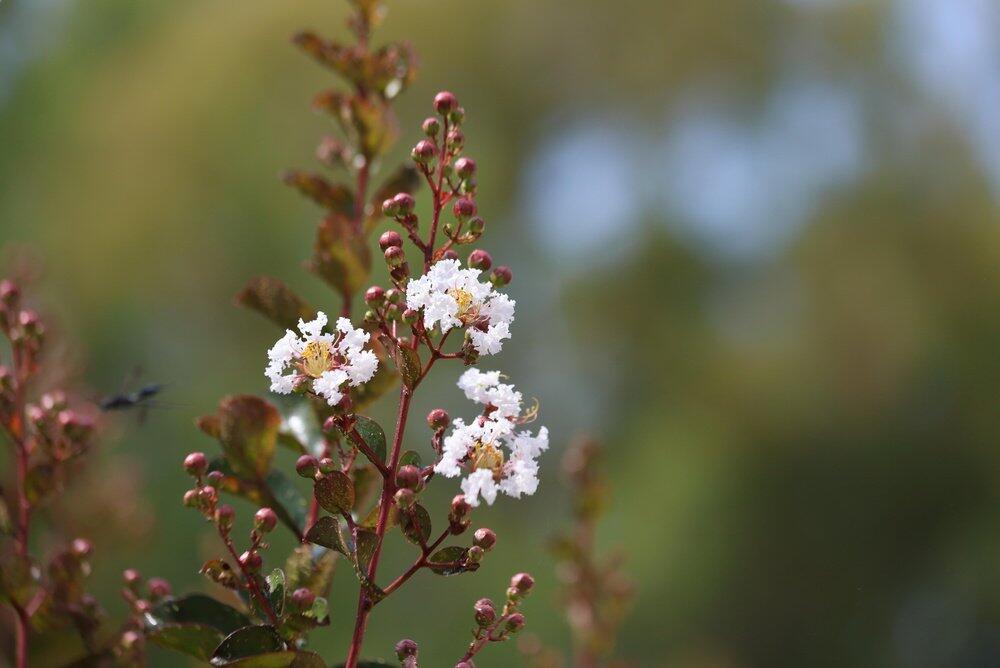
Natchez crape myrtle bark is popular because it peels away in thin sheets to reveal smooth trunks in rich cinnamon, tan and cream, a display that many gardeners rank as the finest bark of any crape myrtle. The bark is the main reason Natchez stays beautiful all winter.
The color deepens as the trunks thicken, so a Natchez tree gets more striking with every year. To show off the bark, train a young tree to three or five evenly spaced trunks and remove the lowest side branches as the tree grows, lifting the canopy so the trunks are on display.
| Season | Natchez crepe myrtle highlight |
|---|---|
| Spring | Glossy new leaves on a clean, multi-trunk frame |
| Summer (late June–September) | Pure white flower clusters |
| Fall | Orange to red leaves |
| Winter | Cinnamon-brown peeling bark |
Choose Natchez for white flowers and the largest size, Muskogee for soft lavender flowers on a 20- to 25-foot tree, and pink crepe myrtle for classic pink summer blooms on a tree typically 15 to 25 feet tall. All three are hardy in zones 7–9.
Pairing two colors makes a crape myrtle planting even more memorable: white Natchez between lavender Muskogee crepe myrtle or classic pink crepe myrtle lets each color stand out. Want to mix four colors in one order? Our crepe myrtle tree page offers Natchez White, Muskogee Lavender, Tuscarora Pink and Dynamite Red.
Plant a Natchez crepe myrtle in full sun, with at least 6 hours of direct light a day, in well-drained clay, loam or sandy soil. Natchez is heat loving and drought tolerant once established, and full sun brings the heaviest bloom.
White flowers glow against dark green, so set Natchez in front of evergreens. A screen of Green Giant arborvitae or a southern magnolia makes a deep green backdrop, and Wintergreen boxwood edges the bed in front. For summer color at the base, add rose mallow and black-eyed Susan. Browse all colors in our crepe myrtle trees collection, or see more flowering trees.
Plant a bare-root Natchez crape myrtle while it is dormant, from November through April, with the root collar at soil level, and prune it in late winter, January through March, removing only crossing branches and shoots at the base. Natchez blooms on new growth, so its natural form flowers freely without heavy cutting.
At our Altamont, Tennessee nursery, Natchez crape myrtles are lifted from the field in winter, root-wrapped to stay moist in transit, and shipped as dormant young trees that settle in fast.
Botanical Name: Lagerstroemia 'Natchez' (L. indica 'Pink Lace' × L. fauriei)
Plant Family: Lythraceae, the loosestrife family
Ships: Bare root, 1–2 ft, 2–3 ft or 3–4 ft
Planting Zone: 7–9
Height at Maturity: 20–30 feet
Spread: 15–20 feet or more
Spacing: 15–20 feet apart
Sun or Shade: Full sun, 6+ hours daily
Water Needs: Weekly deep watering in year one, then drought tolerant
Soil: Well-drained clay, loam or sand
Bloom Season: Late June–September
Flower Color: Pure white
Bark: Cinnamon-brown, peeling
Fall Color: Orange to red
Origin: U.S. National Arboretum hybrid, introduced 1978
Care: Prune in late winter, January through March, removing crossing branches and base shoots. Water weekly the first summer.
Plant Attributes: Long white summer bloom, cinnamon bark, large tree form, fall color, heat and drought tolerant
Natchez crape myrtles grow 20 to 30 feet tall and 15 to 20 feet wide or more, with a broad, multi-trunk canopy.
A Natchez crape myrtle grows at a moderate to fast rate, often 1 to 3 feet per year in full sun once established.
Natchez crepe myrtle blooms from late June into September, giving one of the longest flowering seasons of any crape myrtle.
Plant Natchez crape myrtles 15 to 20 feet apart, and at least 10 feet from a house, driveway or walk.
Prune a Natchez crepe myrtle in late winter, from January through March, before new growth begins, removing crossing branches and shoots at the base.
Yes. Natchez crepe myrtles are cold hardy in USDA zones 7 through 9 and return with fresh growth and flowers each summer.
TN Nursery has grown hardy plants since 1959, more than 65 years of experience, and has supplied plants to major U.S. landmarks like the Washington Monument and Arlington National Cemetery. At our Altamont, Tennessee nursery, we dig and pack Natchez crape myrtles bare root during the dormant season and ship them to sunny landscapes from Virginia to Texas and California. Want to learn more first? Read How to Grow Natchez Crepe Myrtle, Natchez Crepe Myrtles and The Mesmerizing World of Crepe Myrtles on our garden blog.

Since 1959, TN Nursery has grown and shipped quality bare root plants nationwide. Shipped during dormancy, bare-root plants develop strong root systems and establish quickly. Our experienced team carefully harvests and packages every order, providing growers with trusted plants backed by over 65 years of nursery experience.
Learn More About
Bare root trees
Beautiful White Blooms:
Large, pure white flowers that brighten your garden all summer
Distinctive Bark:
Peeling bark with a multi-toned appearance for year-round interest.
Easy to Grow:
Easy to care for, thriving in various soil types and conditions.
Year-Round Appeal:
Vibrant blooms, striking bark, and lush foliage through all seasons.
Fall Digging
Spring Digging
Packing Orders
Customer Unboxing Video
Product Highlight
My Natchez Crepe myrtle tree is doing so well> Very happy with it !
I ordered a pair of these. Received the order within a couple of days. The plants are dominant at this point but looked great. Nice amount of roots and plenty of upward branches to work with. Can't wait for spring.
Ordered 4 and had 5 come to life...thank you.
Know it will be a few years but am anticipating the bark on the tree in the late fall.
Love this species of Crepe myrtle.
Got two for price of one . What a deal.
My trees arrived on time and we planted them the day after. Looking forward to seeing the grow.
Everything was just as expected. I even received an extra one or two.
I’m exited on these baby trees ! 🌲
Just planted this Crepe Myrtle and hope it will do well and grow fast.
This is my first tree ordered from this nursery and so far very satisfied.
Rec'd my entire order earlier than expected. Plants packaged securely. Can't wait to see them look as great as the pictures I ordered from.
Looks great. Planted then and can not wait for spring!!!!
Arrived in good condition. Appears to be quality specimen. Will continue to order from this site
Natchez Crepe Myrtle
Natchez Crepe Myrtle
Natchez Crepe Myrtle
Delivery was on time and the product was in good shape. Already showing signs of healthy growth
I am explicitly happy looking into this specie in my frontyard. I need to order more of this so i can line this up beautifully.
Love it
I looked all over for a purple crepe myrtle and was about to give up hope that a family member would not have the memorial tree in her favorite color. Thank You so much!
For the money these are the best deal around- I bought several elsewhere that arrived 8" high! These were several feet tall with real roots and branches and should become small trees in no time!
My wife loves it it has grown at least 3 feet in 2020 thank you so much.
We spotted your 5-star review. Wow! Thank you so much for trusting us, and we can’t wait to help you again in the future.
this is a great product. All mine are doing exceptionally well. Shipped fast packed well I'm in love with my shrubs I've ordered. They look great in my yard.
I LOVE THEM SO MUCH THEY SMELL SO GOOD
The tree arrived - bare root and neatly packaged - within 3-4 days of me placing the order. I have planted it in the ground. Now to wait for spring and see how it goes.
Love my plants. ic ant wait to see them in the spring time when they bloom out.
Came packaged nicely. It's fall so I don't know what it will look like until spring. Now I just have to wait until then.
these are simply amazing
absolutely stunning great quality of plats highly recommend tn nursery
This plant is good. I like it. I thought it was “great” but it is actually crepe. Good for the French people
What a great size the trees were on arrival! They were totally dormant, of course, and seemed to take forever to leaf out. But leaf out they did, and now all four are happily growing. These are really good trees at a great price. Thank you for the good service and great product!
Just planted so hoping the do well once in the ground