When freezing rain coats a tree, every twig carries its own sheath of ice. In late January 2026, Winter Storm Fern showed Middle Tennessee what that means: splintered and fallen trees across Nashville, weeks of cleanup, and later a state Urban Forest Strike Team sent in to assess the damage. Ice season is coming back around, so we pulled together the research on which trees hold up under ice and which ones tend to break.
The infographic below groups 32 common yard and street trees as resistant, intermediate or susceptible to ice storm damage. It draws on research led by Richard Hauer (University of Wisconsin–Stevens Point) and Jeffrey Dawson (University of Illinois), as published by UNH Extension and Connecticut's forestry division, plus the University of Kentucky's forestry extension. It's free to share with credit.
Share this infographic
FacebookPinterestXLinkedInEmailWant it on your website? Scroll down for the free embed code.
Ice storms by the numbers
- 10 to 100 times heavier: ice accumulation can increase a branch's weight by a factor of 10 to 100 (Hauer, Werner & Dawson, 2008).
- A quarter inch is the threshold: the National Weather Service calls it an ice storm at 1/4 inch (0.625 cm) of ice on exposed surfaces. Ice on stems usually ranges from a trace to 1 inch, and in extreme storms up to 8 inches.
- Peak season is winter: 90% of these storms happen between December and March, and most hit in January.
- The bill is large: ice storms cause an estimated $250 million in losses a year. Insured losses from freezing rain totaled $16.3 billion from 1949 to 2000 (in 2000 dollars), and the 1998 storm across the northeastern U.S. and southeastern Canada caused an estimated $6.2 billion in losses.
- Big storms come back: extreme, widespread ice storms tend to return to a region every 10 to 20 years.
Ice storm resistance ratings for 32 trees
Three research-based lists rate the same trees, and they mostly agree. Where they don't, we show all three so you can see the spread.
| Tree | Our grouping | UNH Extension | Hauer et al. table (CT DEEP) | Univ. of Kentucky |
|---|---|---|---|---|
| White oak | Resistant | Resistant | Resistant | Intermediate |
| Swamp white oak | Resistant | Resistant | Resistant | Intermediate |
| Bur oak | Resistant* | Intermediate | Resistant | Resistant |
| Black walnut | Resistant* | Resistant | Resistant | Intermediate |
| Hickories (shagbark, pignut, bitternut) | Resistant | Not listed | Resistant | Resistant |
| Kentucky coffeetree | Resistant | Resistant | Resistant | Resistant |
| Ginkgo | Resistant | Resistant | Resistant | Resistant |
| Sweetgum | Resistant | Resistant | Resistant | Intermediate |
| Bald cypress | Resistant | Not listed | Resistant | Resistant |
| Black gum | Resistant | Not listed | Resistant | Resistant |
| Eastern red cedar | Resistant | Not listed | Resistant | Resistant |
| Arborvitae | Resistant | Resistant | Not listed | Not listed |
| Littleleaf linden | Resistant | Resistant | Resistant | Not listed |
| Red maple | Intermediate | Intermediate | Intermediate | Intermediate |
| Sugar maple | Intermediate | Intermediate | Intermediate | Intermediate |
| Northern red oak | Intermediate | Intermediate | Intermediate | Not listed |
| Eastern white pine | Intermediate | Intermediate | Intermediate | Intermediate |
| Pin oak | Intermediate* | Susceptible | Intermediate | Intermediate |
| Green ash | Intermediate* | Susceptible | Intermediate | Intermediate |
| Silver maple | Susceptible | Susceptible | Susceptible | Susceptible |
| American elm | Susceptible | Susceptible | Susceptible | Susceptible |
| Siberian elm | Susceptible | Susceptible | Susceptible | Susceptible |
| Black locust | Susceptible | Susceptible | Susceptible | Susceptible |
| Honeylocust | Susceptible | Susceptible | Susceptible | Susceptible |
| Bradford (Callery) pear | Susceptible | Susceptible | Susceptible | Susceptible |
| Hackberry | Susceptible | Susceptible | Susceptible | Susceptible |
| River birch | Susceptible | Not listed | Susceptible | Susceptible |
| Black cherry | Susceptible | Susceptible | Susceptible | Susceptible |
| American basswood (linden) | Susceptible | Susceptible | Susceptible | Susceptible |
| Eastern cottonwood | Susceptible | Not listed | Susceptible | Susceptible |
| Willows | Susceptible | Not listed | Susceptible | Susceptible |
| Tulip poplar | Susceptible* | Intermediate | Susceptible | Susceptible |
* The sources disagree; we grouped the tree by the majority rating. Linked tree names go to TN Nursery product pages.
Why some trees break and others bend
You might expect hard, dense wood to be the deciding factor. The researchers found otherwise: "the wood strength of sound branches matters less than the ability of a tree to withstand breakage at branch junctures." The traits that raise the risk are weak forks with included bark (bark pinched inside a tight V-shaped crotch), decay or dead branches, broad or lopsided crowns, lots of fine lateral branches that collect ice, and shallow or restricted roots.
That explains the susceptible column. Siberian elm, American elm, hackberry, green ash and honeylocust have broad crowns that load up with ice. The original Bradford pear is a textbook case: its branches often split where included bark formed in tight forks. Silver maple, black locust and cottonwood pair fast growth with brittle limbs.
Resistant trees share a different set of traits. Black walnut, Kentucky coffeetree and sweetgum have coarse branching, with fewer, thicker limbs that hold less ice. Bald cypress and ginkgo have a conical, central-leader form that sheds load down the trunk. Small trees also tend to fare better simply because there is less to break.
The best ice-resistant trees to plant
If you're replacing storm losses or planting near a house, these natives rate well:
- White oak: rated resistant by UNH and the Hauer table. It's long-lived, with strong branch attachments.
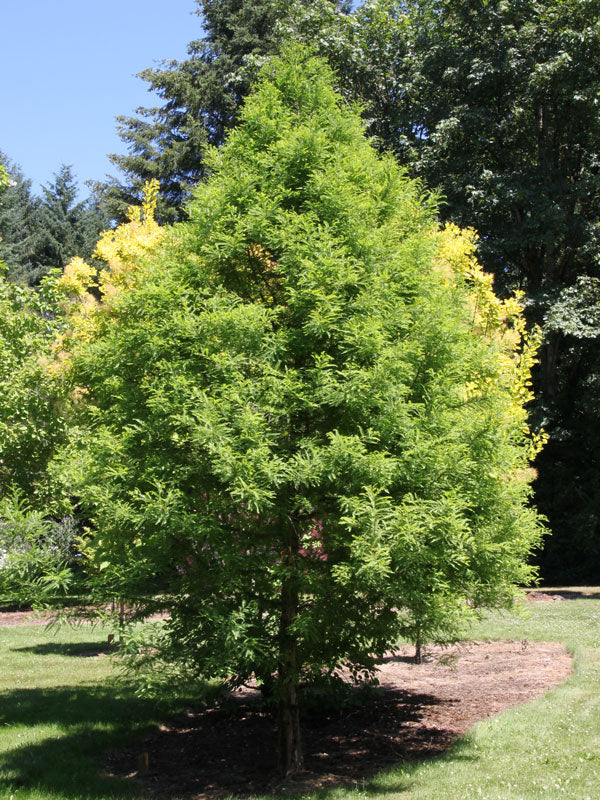
- Bald cypress: a conical deciduous conifer that's resistant in both the Hauer and Kentucky lists. It also handles wet spots.
- Black walnut: coarse branching makes it a resistance example. Kentucky rates it intermediate and noted severe top damage in the 2009 western Kentucky storm, so give it room.
- Eastern red cedar and American arborvitae: dense native evergreens rated resistant, good for screens and windbreaks.
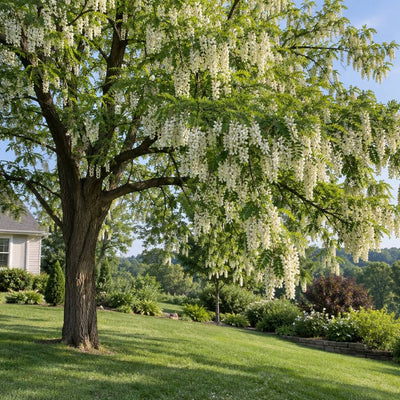
- Black gum, hickories and Kentucky coffeetree: all rated resistant, and all good choices for a long-term shade canopy.
Red maple, sugar maple and northern red oak land in the middle. They're still excellent trees, but plant them where a dropped limb won't hit the roof, and start structural pruning early. You can browse more choices in our shade trees and native trees collections.
What about redbud, pawpaw and dogwood?
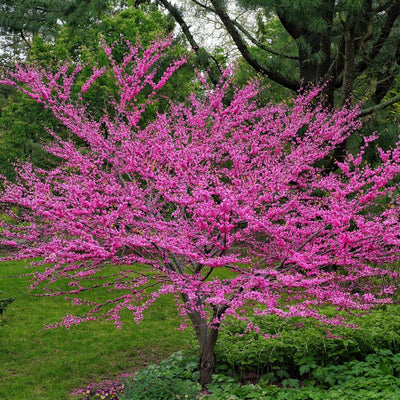
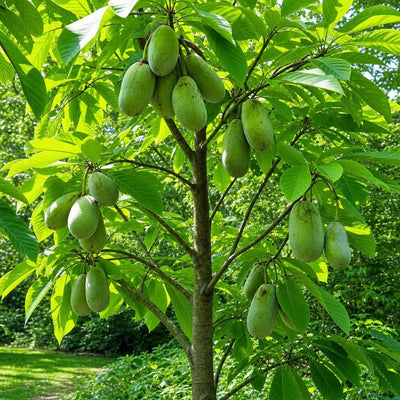
None of the three rating lists includes eastern redbud, pawpaw, flowering dogwood or crepe myrtle, so we haven't rated them. The research does list small stature as a resistance trait, and those are all small understory or ornamental trees. That makes redbuds and pawpaws sensible picks for small yards, though they haven't been formally rated. Use the free planting zone calculator to check what fits your zone.
Before the next ice storm: 5 steps
- Prune young trees for structure. UNH Extension notes that trees pruned regularly from a young age should be more resistant. Keep one central leader and remove competing tight forks.
- Look for included bark. V-shaped forks with bark pinched between the stems are where ice-loaded trees most often split. Have a certified arborist look at big ones over the house.
- Remove dead and decaying limbs before winter, when they're easy to spot.
- Put the right tree in the right place. Keep susceptible, broad-crowned species away from roofs, driveways and power lines, and choose resistant species for those spots.
- Judge damage carefully afterward. University of Kentucky forestry guidance treats more than 30% crown loss in oaks and hickories, more than 50% in fast-growing species, or a trunk bent more than 50 to 60 degrees, as signs of permanent injury. Ice after the sap rises in late winter is worse, because breaking branches can strip bark down the stem.
Want more on long-lived trees? See How Long Do Trees Live? and our 10 tree planting myths, busted.
Shop ice-resistant native trees


Share this infographic
Copy the code below and paste it into your website, blog or newsletter. It shows the infographic with a credit link to TN Nursery.
<p><a href="https://tnnursery.net/blogs/garden-blog/ice-storm-resistant-trees">Which Trees Survive Ice Storms? Ice storm resistance ratings for 32 trees</a> – free infographic by <a href="https://tnnursery.net">TN Nursery</a></p>
Journalists, teachers and extension offices are welcome to use the ratings with credit. Find more on our free infographics page.
Sources
- Hauer, R.J., Werner, L.P. & Dawson, J.O. (2008). "Why Trees Fail During Ice Storms: Developing Greater Ice Storm Resistant Tree Populations." ISA 84th Annual Conference, St. Louis. PDF via CT DEEP
- "Ice storm susceptibility of tree species found growing in urban areas," adapted from Hauer et al. (1993) and 42 publications. CT DEEP Forestry
- UNH Cooperative Extension, "Ice Resistant Tree Populations," adapted from Hauer, Hruska & Dawson (1994), rev. 2009. extension.unh.edu
- Stringer, J. (2009). "Ice Damage: Managing Woodland Damage and Health," FORFS 09-03, University of Kentucky Cooperative Extension. PDF via KY Energy & Environment Cabinet
- Tennessee Department of Agriculture (Feb. 27, 2026). "Urban Forest Strike Team to Assess Ice Storm Tree Damage in Nashville." tn.gov
About TN Nursery
TN Nursery was founded in 1959 by Roscoe Tate and grows native plants on 170 acres in Tennessee. We've grown about 2 million pawpaw trees from roughly 2 tons of seed and more than 200,000 redbuds, and our plants have been supplied to the Washington Monument and Arlington National Cemetery.