
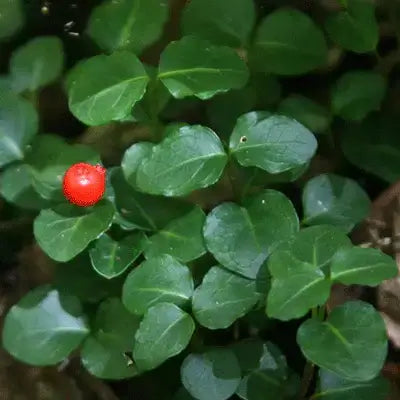
Partridgeberry: A Charming Evergreen Ground Cover for Shade
Partridgeberry (Mitchella repens) is a delightful, slow-growing native ground cover that thrives in moist, shaded woodland gardens. Its tiny, glossy evergreen leaves, fragrant white flowers and bright red winter berries bring year-round beauty to the forest floor.
Introduction
Partridgeberry belongs to the coffee family (Rubiaceae) and is native to eastern North America, from southeastern Canada south to Florida and west to Texas. It is also known as twinberry, two-eyed berry and running box. Its common name comes from the ruffed grouse, often called a "partridge," which feeds on its berries.
The plant is a trailing, evergreen perennial that hugs the ground, usually just 1 to 2 inches tall, with stems that creep along the soil and root as they go, slowly forming a mat 1 to 2 feet wide. Its small, rounded, glossy leaves are dark green with a pale midvein and grow in opposite pairs.
Twin Flowers and Two-Eyed Berries
In late spring and early summer, partridgeberry produces fragrant, white, trumpet-shaped flowers with fuzzy petals. The flowers always come in pairs that share a single base. Both flowers in a pair must be pollinated to form fruit, and the two fuse into a single bright red berry marked with two small dimples, or "eyes," one from each flower.
The red berries ripen in fall and often last through winter and into the next spring, brightening the winter garden. They are edible but mild and seedy, and they are a valuable winter food for grouse, wild turkeys, foxes and other wildlife.
Growing Partridgeberry
Partridgeberry is hardy in USDA zones 3 to 9. It thrives in partial to full shade in moist, well-drained, acidic soil rich in organic matter, just like the soil of a woodland floor.
- Planting: Space plants 6 to 12 inches apart and set them at the same depth they were growing. Water well after planting.
- Watering: Keep the soil evenly moist, especially during the first year and during dry summer spells.
- Mulching: A light layer of shredded leaves or pine needles helps hold moisture and protects the roots in winter.
- Care: Partridgeberry needs almost no maintenance. Simply let it creep and fill in over time.
Uses in the Landscape
Partridgeberry makes a beautiful evergreen carpet beneath shrubs and trees, along shaded paths and among rocks in woodland gardens. It pairs wonderfully with ferns, wild ginger, trilliums and other shade-loving natives, and it thrives alongside acid-loving shrubs such as rhododendrons, azaleas and blueberries.
It is also a favorite for terrariums and holiday decorations, where its glossy leaves and red berries add a touch of woodland charm.
A Plant with a Long History
Partridgeberry has a long history in North American folklore and traditional herbal practices, particularly among Native American peoples. Today, it is grown primarily as an ornamental ground cover and for its value to wildlife.
Find partridgeberry, wild ginger, European ginger and many other shade-loving ground covers at TN Nursery.


