
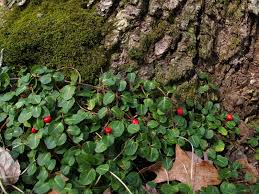
Growing Mitchella Repens
Mitchella repens, better known as partridgeberry, is a charming native evergreen groundcover that creeps slowly across the forest floor. It grows only 1 to 2 inches tall, with trailing stems that spread a foot or more and root as they go. Its small, round, glossy dark green leaves often have a pale stripe down the middle, and they stay attractive all year.
Partridgeberry blooms in late spring and early summer with pairs of small, fragrant, funnel-shaped white flowers, sometimes tinged with pink, each with four fuzzy petals. The two flowers of each pair fuse to produce a single bright red berry, which you can see marked with two tiny dimples. The berries often last through winter and are enjoyed by ruffed grouse, wild turkeys, bobwhite quail and other wildlife.
Partridgeberry is native to eastern North America, from southeastern Canada and Minnesota south to Florida and Texas. It grows naturally in moist woodlands, on shady slopes and along stream banks.
Caring for Your Mitchella Repens
Partridgeberry thrives in partial to full shade and moist, well-drained, humus-rich, acidic soil. It is hardy in USDA zones 3 to 9. Water regularly until it is established, and keep it mulched with shredded leaves to hold moisture.
Because of its low size and minimal care needs, partridgeberry is a wonderful groundcover for shady woodland gardens, rock gardens, between stepping stones and beneath trees and shrubs. Its glossy evergreen leaves and red berries keep garden beds looking lively through the winter months, and it is also a favorite for terrariums. Pair it with ferns and other shade-loving native perennials for a beautiful woodland scene.
Buy Partridgeberry at TN Nursery
Order Partridgeberry and all your plant needs at TN Nursery.

