
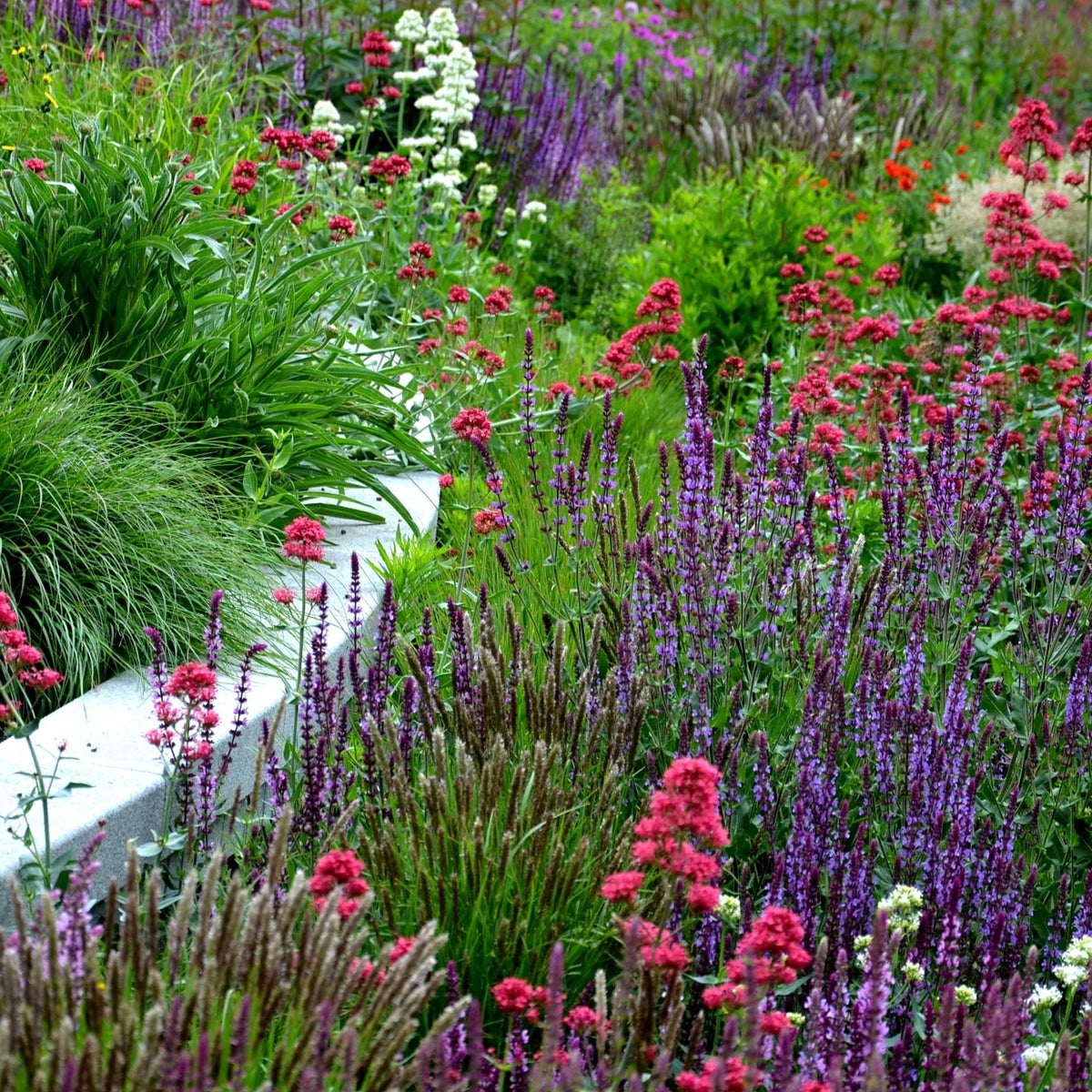
The best perennial flowers are the best and will add to the scenery, long-term color, seasonal structure, and some guarantees of perfection every year. Perennial flowers for landscaping are stronger throughout each season, and this has made them provide an economic and ecologically feasible alternative to include in the Tennessee garden. At TN Nursery, we have observed the customary tendency of some kinds of crops that grow throughout the year to do the most spectacular work anywhere where they happen to reside.
Why Choose Perennial Flowers for Your Landscape?
The perennial flowers come back every year and are also planted once and undergo endless growth without the need to replenish and form extra root mass, which contributes to soil organic matter and temporal stability of the soil structure on the long-run scale.
Low-maintenance perennial flowers can be maintained with far less continuous investment than can be the case with annuals. Perennial flowers for landscaping also sustain the pollinating insects throughout the year as they overlap, and thus, in spring, summer, and fall in succession, the bees, butterflies, and hummingbirds would have a steady source of nectar. It is always advisable to use the best perennial flowers, as they are the mainstay of any long-term landscape in Tennessee, which is what TN Nursery recommends. The biology and seasonal behavior of perennial plants are well covered in articles on perennial plants.
Top Perennial Flowers for a Stunning Landscape
The best perennial flowers to plant in Tennessee are those species that are able to survive in Tennessee's soils, humidity, and seasons.
Dwarf Crested Iris
A delicate native perennial (Iris cristata) that produces lavender-blue blooms tipped with golden crests, which open in shaded woodland gardens at the start of spring. The Dwarf Crested Iris grows to a height of 4–6 inches, thus qualifying to be one of the best easy-to-grow perennial flowers in Tennessee borders.
Anemone Plant
A stunning perennial (Anemone canadensis) whose flowers are white with flowery, buttery centers in the wet, sunny, and part shade flower boxes on the borders around the entire summer and late spring. The Anemone Plant is 1–2 feet high and can be propagated—it is one of the best perennial flowers that come back every year to grow naturally in a large area within the garden.
Periwinkle Plants
The Periwinkle Plants breed at a slow pace, and heaps of matted weeds of eternal color of the seasons. They also manufacture the best low-maintenance perennial flowers for ground-level cover in Tennessee landscapes.
Orange Daylily
A native and heat-tolerant type of perennial plant (Hemerocallis fulva), in which the flower is deep orange, that flowers in the summer season of the year and has a very high drought resistance after it is rooted. The Orange Daylily is planted at an average rate of 2–4 feet and is then allowed to grow naturally in order to occupy the two sides of the garden.
Lyreleaf Sage
An indigenous shrub (Salvia lyrata) that carries a high spike of lavender-blue flowers, which are rosettes at the center of the green leaves on the foliage during the spring and early summer. The Lyreleaf Sage grows 1–2 feet high and is one of the least challenging, best perennial flowers to plant to naturalize in Tennessee gardens.
How to Design a Landscape with Perennial Flowers?
Perennial flowers for landscaping have improved with the type of soils as well as the positions in which they are set up that offer a wide range of color, unlike height, not to mention the overlapping time horizon of blossom around the same time of the year—spring, summer, and fall.
- Layer by height: Place tall, best perennial flowers at the back of borders and lower-growing Dwarf Crested Iris and Periwinkle Plants at the front to be able to create the depth of the layer effect and flow.
- Extend the bloom season: Select the best perennial flowers to plant at different times of the year—do early, mid, and late—lest there should be no time gap between the first warm days and the first frost.
- Group in odd numbers: Plant low-maintenance perennial flowers in threes or fives at the same time, rather than one at a time, so that they can more easily attract pollinators and provide visual impact.
Step-by-Step Guide to Growing Perennial Flowers
As a matter of fact, it has been observed that easy-to-grow perennial flowers can grow easily and do well when they are planted in the right manner and taken care of at a tender age.
- Soil preparation: Prepare the planting beds using 2–3 inches of organic materials in the upper 12 inches of the soil to enhance growth.
- Planting depth: Deep perennial flowers come back every year. Varieties should receive the same depth of planting every year as they did in their containers.
- Watering: Twice a week during the first 4–6 weeks. The vast majority of the plants grown as low-maintenance perennial flowers can sustain themselves without irrigation on the natural rainfall during the normal seasons of Tennessee.
- Mulching: Apply 2–3 inches of organic materials around the best perennial flowers to ensure that they remain moist so that the soil temperature is regulated and the population of the soil organisms in decomposing them is maintained.
- Deadheading: Deadhead blooms every now and then of easy-to-grow perennial flowers so that when the season grows, the flower buds can grow new flowers.
TN Nursery has still maintained the statement that the best perennial flowers to plant have good soil ready ahead of time and are planted early in the season, as they will be far stronger the first season than the plants planted after the soil has not been prepared.
Conclusion
The Tennessee landscapes will be colored and low-maintenance and thriving outdoor landscapes due to the best perennial flowers with an extended beauty season. TN Nursery offers trusted quality plants, including Dwarf Crested Iris, Anemone Plant, Periwinkle Plants, Orange Daylily, and Lyreleaf Sage—all proven to provide lasting beauty and reliable perennial flowers for landscaping results across Tennessee.
FAQs
What are the best perennial flowers for landscaping?
The rare Dwarf Crested Iris, Orange Daylily, and Lyreleaf Sage are some of the most suitable and useful perennial flowers that can be used in Tennessee landscapes to make sure that flowers are in color at a certain season, though weather conditions are taken into account.
Which perennials are easiest to grow for beginners?
Orange Daylily and Periwinkle Plants are some of the best easy-to-grow perennial flowers that are not complicated to cultivate, besides the fact that they grow very fast and can be depended on with minimum care.
Do perennial flowers require a lot of maintenance?
No, the majority of the low-maintenance perennial flowers will be content with the minimum of watering, yearly application of the mulch, and periodical splitting when well established in Tennessee landscapes.
Do perennial flowers grow every year?
Yes, perennial flowers come back every year and root deeper with every passing year in comparison to annual ones, because annual flowers have to be planted every year.
What is the easiest perennial flower to grow?
Orange Daylily and Periwinkle Plant are classified as the simplest, best perennial flowers to plant, as they reproduce naturally and are self-growing, virtually requiring no repetitive attention.
Which flowers are perennials?
The other examples of good perennial flowers for landscaping would be the Dwarf Crested Iris, the Anemone Plant, the Orange Daylily, the Lyreleaf Sage, and the Periwinkle Plants, among others.
Where can I buy perennial plants online?
TN Nursery is involved with the sale of good-quality perennial flowers and plants for landscaping that will thrive in Tennessee landscapes.


