
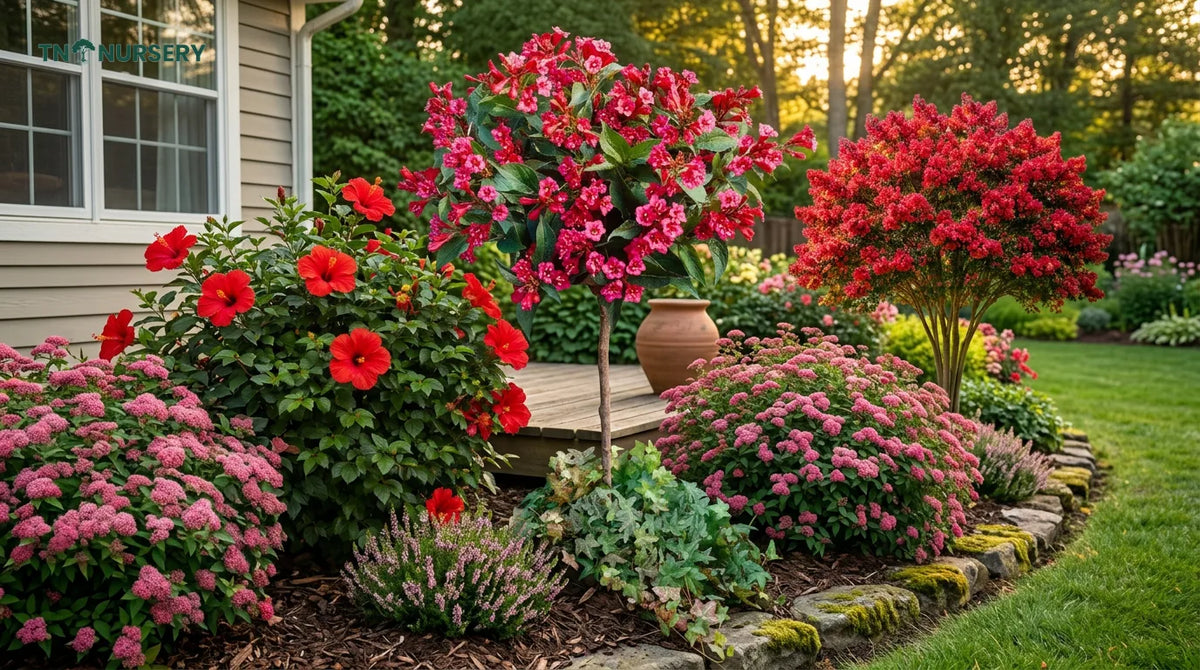
We show you practical pairings for curb appeal, pollinators, and easy upkeep, including how to plant red weigela with trees in front-yard and side-yard borders.
What are the best red weigela companion plants to buy?
- Red weigela suits Zones 4 to 8 and stays manageable at about 4 to 6 feet tall.
- Successful pairings share sun exposure, moderate moisture, and staggered bloom windows.
- The strongest borders mix forms, including mounded shrubs, upright accents, and layered heights.
- We’ll focus on usable combinations for flowering shrub ideas for curb appeal, not random plant lists.
Start Your Red Weigela Companion Plants Plan Here

Red Weigela as the Mid-Layer Anchor for Summer Borders
If you're planning red weigela companion plants, this is the shrub we would build around first. Our Red Weigela Shrub for summer borders brings rich red trumpet-shaped blooms in late spring to early summer, dense green foliage, and a natural fountain-like shape when left unpruned. It fits the middle of the border beautifully at 4 to 6 feet tall and wide, and it bridges lower mounded plantings with taller flowering trees.
- Rich red blooms from late spring to early summer, with repeat flowering later in summer
- Attracts butterflies and hummingbirds with trumpet-shaped flowers
- Thrives in Zones 4-8 in full sun to partial shade, with best flowering in 6 hours of direct sun
How to Build a Strong Red Weigela Border
When you plan red weigela companion plants, think in three layers: bloom time, height, and color. Weigela gives you that late spring burst, but the bed looks fuller when something flowers before it and something carries color after it. That is how we keep a summer border active instead of flashy for two weeks and quiet the rest of the season.
What are the best red weigela companion plants to buy?
Start with structure first. Small flowering trees behind or just off-center give the bed height, while weigela holds the middle and lower shrubs soften the front edge. Trees people often compare for this job include white flowering dogwood, eastern redbud, rising sun redbud, western redbud, and forest pansy redbud tree.
For color, we prefer contrast over a wall of red. A red border gets more depth when you break it with white bloom, pink tones, or plain green foliage. But keep in mind, too much burgundy nearby can make the planting feel heavy.
Bloom timing that keeps the bed moving
- Early spring: Use a flowering tree to wake up the bed before weigela starts.
- Late spring: Let red weigela take the main role with its strongest bloom cycle.
- Midsummer: Add later color and steady foliage so the border still reads full in heat.
Height layering that reads clean from the street
- Back or off-center: Place trees where they frame the bed, not directly behind every shrub.
- Middle layer: Set weigela as the anchor with room for its mature spread.
- Front layer: Keep lower shrubs in front so flowers stay visible from the curb.
How to plant red weigela with trees
Give weigela enough room from the trunk so it still gets sun from the side and above. We usually avoid crowding it into the root flare, because tree roots compete hard for water and nutrients. So leave open soil between the trunk and shrub, and plan for airflow once both reach mature size.
That spacing matters at pruning time too. Weigela blooms on old wood, so prune right after flowering, not in late winter. If you wait too long, you cut off next season's flower buds.
Color contrast ideas for curb appeal
If you are searching for flowering shrub ideas for curb appeal, use red as the accent, not the only note. A red twig dogwood shrub adds strong winter stems, while red flowering currant brings another red-pink bloom period people often compare in mixed borders.
Quick rule: give each plant its own outline. When branches overlap too early, flowers disappear, air slows down, and the border looks crowded fast.
Red Weigela Companion Plants for Better Curb Appeal
These three picks build a longer season around red weigela companion plants. We use spirea to soften the shrub line, then add a taller red accent so color carries from late spring into summer when you plan how to plant red weigela with trees.


How to Plant Red Weigela With Trees for Height and Longer Color
When red weigela needs taller partners, we place spring structure behind it with the Red Dogwood Tree and carry color deeper into heat with the Red Crepe Myrtle. You’ll find this pairing useful for layered red weigela companion plants that add curb appeal without crowding the border.

The Upright Accent
Red dogwood brings vertical structure and spring interest for gardeners pairing shrubs with a small ornamental tree.

The Summer Follow-Up
Red crepe myrtle extends the flowering story into summer, making it a useful partner in a longer-season border.
Compare 6 Border Picks for Red Weigela Companion Plants and Curb Appeal
Use this quick shop grid to compare the six plants we featured for summer borders. We started with Red Weigela Shrub as the anchor shrub, then added lighter mounded fillers in Japanese Spiraea and Pink Spirea Shrub to soften the front edge and stretch bloom time.
Frequently Asked Questions
What are the best red weigela companion plants to buy?
For layered summer color, we pair red weigela companion plants with small flowering trees that change the view above the shrub line. A rising sun redbud brings warm gold and orange-toned foliage, while a white flowering dogwood cools the border with clean spring bloom. If you want stronger branch color after leaf drop, a red twig dogwood shrub adds winter contrast that weigela cannot give on its own.
How far apart should I plant red weigela from other shrubs or small trees?
Give red weigela enough room so its arching branches can fill out without rubbing against nearby plants. We usually suggest leaving several feet between the weigela and a red twig dogwood or red flowering currant, and more space when planting near an eastern redbud tree or western redbud. Look at the mature spread first, not the pot size. That saves you from a crowded border in three years.
Can I mix red flowers with pink and white in one border?
Yes, and it often looks better than an all-red planting. Red weigela plays well with the pink bloom of an eastern redbud and the lighter flowers of white flowering dogwood. Keep one color as the lead, though. Too many strong reds together can make a narrow front-yard border feel busy.
What is the best location for weigela in a layered planting?
Place red weigela in the middle layer where you can see the flowers and the full shape. Put taller flowering trees like forest pansy redbud tree behind it, and keep lower perennials in front. So, think in steps: tall in back, weigela in the middle, ground-level color at the edge. That layout gives you depth without hiding the shrub.
Should I prune red weigela before or after flowering?
Prune after flowering, not before. Red weigela blooms on older wood, so a hard spring cut removes the buds you waited for. We trim out stray stems right after bloom and shape lightly. But keep in mind, heavy pruning can reduce the next flush and make the plant look sparse for a season.
Which companion type gives the longest season of interest?
If you want the longest show, choose a companion that adds something after spring flowers fade. A red twig dogwood gives bright winter stems, and a rising sun redbud keeps colorful foliage through the growing season. For curb appeal across more months, that mix beats a border built only around bloom time.
How does TN Nursery ship live plants?
We ship all items by 3-4 day ground shipping. That applies to our live plants across the store. We keep the process straightforward so you know what to expect when you order for a new border or foundation planting.
What if there is a problem with my order, and how can I contact you?
TN Nursery does not offer refunds or accept returns. If there is a problem, we may offer a reshipment if product is available, an extended warranty on a plant, or in-store credit if the product is out. You can reach us at customerservice@tennesseewholesalenursery.com or write to Tennessee Wholesale Nursery, 12847 State Route 108, Altamont TN 37301, United States.
Conclusion
Key Takeaways
- Use red weigela as the mid-height anchor for summer bloom and pollinator appeal.
- Add mounded shrubs nearby to soften the border and fill the lower layer.
- Place flowering trees behind or beside the planting for structure and a longer bloom season.
- Choose pairings by sunlight, mature size, and maintenance needs, not color alone.
- Plan by hardiness zone and spacing so the border stays healthy as plants mature.

