
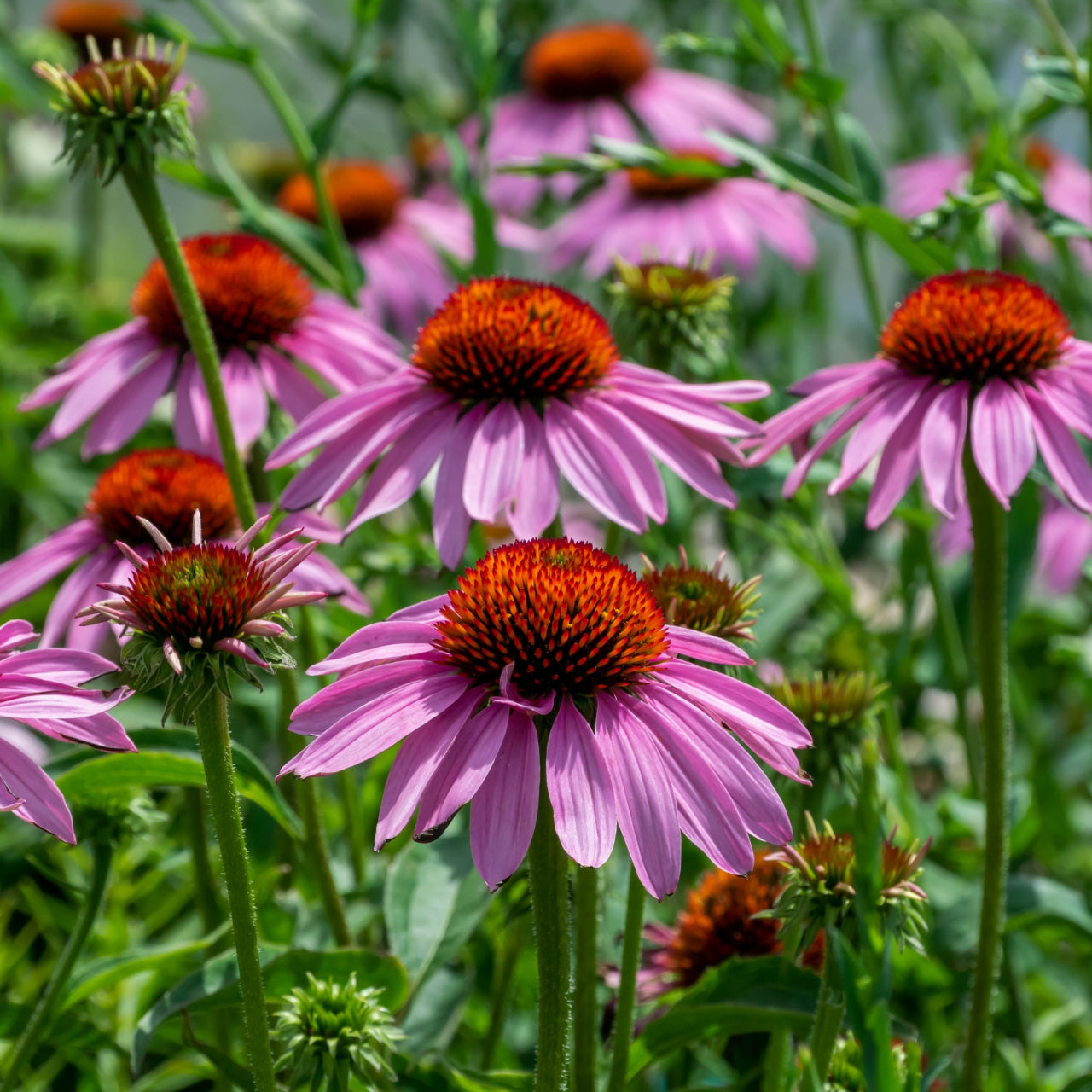
One of the most common frustrations gardeners face is the “summer slump” — that stretch from August into October when the bold spring and early summer bloomers have faded and the garden starts to look tired. Annuals help, but they require replanting every year and often struggle in the late-season heat. What you really want are long blooming perennials that carry color and life through the difficult final months of the growing season.
This is where native fall and summer blooming perennials truly shine. These are plants built — by thousands of years of evolution — to thrive in the conditions that late-season gardens present: intense heat, irregular rainfall, and the slow shift toward shorter days. They bloom when many other plants have already wound down, and in doing so, they provide a critical lifeline for migratory pollinators, late-season butterflies, and native bees preparing for winter.
At TN Nursery, our horticulture team led by founder Tammy Sons has spent decades observing and growing native plants across a wide range of conditions. The six plants in this guide are among our most trusted recommendations for extending garden color and ecological productivity deep into the season.
1. Dandelion Plant (Taraxacum officinale)
Before you scroll past this one, hear us out. Dandelion Plant is one of the most nutritionally and ecologically important plants in the landscape, and its reputation as nothing but a weed is deeply unfair. As a long-blooming perennial that flowers from early spring through fall — with the most significant display in spring but reliable flowering across the warmer months — Dandelion provides one of the longest and most accessible nectar and pollen windows available to early-season and late-season native bees.
-
Why it deserves garden space: More than 90 species of native bees and countless other pollinators rely on Dandelion for food at critical times of year when few other plants are blooming. Its deeply nutritious leaves are edible and have been used in salads and teas for centuries. Its taproot aerates compacted soil and mines deep nutrients, pulling minerals to the surface through root turnover.
-
In the garden: Rather than fighting Dandelion, consider dedicating a naturalistic section of your garden or lawn border where it is welcome. A patch of Dandelion blooming alongside early native bulbs and perennials is a far more ecologically productive spring scene than a monoculture of grass.
- Growing tips: No care needed — Dandelion manages itself with complete efficiency - Avoid herbicide use in areas where you want Dandelion for pollinators - Allow seed clocks to form and disperse naturally to expand coverage.
2. Blue Cohosh Plant (Caulophyllum thalictroides)
Blue Cohosh is a graceful, underutilized woodland native that brings subtle beauty to the shaded garden from spring through fall. Its small, star-shaped greenish-yellow flowers appear in April and May before the compound foliage fully expands, and by late summer, those flowers have matured into striking clusters of deep blue-black berries that persist well into fall.
-
Why it earns its place: Blue Cohosh is one of those plants that rewards careful observation. Its flowers are not showy in a conventional sense, but they have a quiet elegance — particularly against the plant’s unusual blue-green foliage, which has a somewhat waxy quality that makes it stand out even when not in flower. The berries that follow are genuinely beautiful in an understated way.
-
Care tips: - Plant in rich, moist, well-drained woodland soil in part to full shade - Grows best in slightly acidic soil with good organic matter content — the kind of rich, leafy forest soil found in Tennessee’s cove hardwood forests - Allow to naturalize and self-seed; colonies established over several years are particularly effective.
- Ecological note: The berries of Blue Cohosh are eaten by birds but are toxic to humans and pets — something worth noting if you have children or animals in your garden.
3. White Baneberry (Actaea pachypoda)
White Baneberry — also sometimes called “Doll’s Eyes” for the eerie resemblance of its berries to white china eyes — is one of the most visually striking native perennials for the shaded garden. Its small white flowers in spring are attractive but modest; the real show comes in late summer and fall when the berries develop: brilliant white, mounted on thick red stalks, held above bold compound foliage in clusters that are genuinely arresting.
-
Why it earns the long-blooming label: While White Baneberry’s flowers are brief, the plant’s ornamental interest extends across the entire growing season — from the fresh spring foliage through the June flowers through the spectacular fruiting display that peaks in September and October.
-
Care tips: Plant in rich, moist, well-drained woodland soil in part to full shade - Pairs beautifully with Trillium, Solomon’s Seal, and Ferns in a woodland understory planting - Like Blue Cohosh berries, White Baneberry berries are toxic to humans and should be treated accordingly.
- Design note: The bold foliage and dramatic berry display of White Baneberry make it one of the most effective fall-interest plants available for the shaded native garden. Use it as a focal point in a shaded border or woodland path.
4. Lyreleaf Sage Plant (Salvia lyrata)
Lyreleaf Sage is a native salvia that manages to be both understated and surprisingly impactful in the garden. It produces spikes of tubular lavender to blue-violet flowers from April through June, and often again in a lighter second flush in late summer and early fall. The basal rosette of leaves — deeply lobed and often marked with purple — remains attractive and sometimes semi-evergreen through mild Tennessee winters.
-
Why it earns the long-blooming label: Lyreleaf Sage blooms earlier than most summer perennials and continues longer than most spring ones, bridging the gap between seasons with consistent color. Its second bloom in late summer adds to its value as a long blooming perennial in the native garden.
-
Care tips: Thrives in a wide range of conditions — full sun to partial shade, average to poor soil - Tolerates dry conditions once established, making it useful for dry shade situations - Self-seeds freely in favorable conditions; allow natural spread for a naturalized effect.
- Ecological note: The tubular flowers of Lyreleaf Sage are particularly attractive to bumblebees and other native bee species. A patch in bloom in late summer is a reliable pollinator hotspot.
5. Siberian Iris Plant (Iris sibirica)
Though technically native to Europe and Asia rather than North America, Siberian Iris has naturalized across much of the eastern United States and has become a dependable, ecologically functional perennial in Tennessee gardens. Its elegant, beardless flowers — typically in shades of blue, purple, white, and wine — bloom in late May through June, bridging the late-spring to early-summer gap beautifully. The graceful, upright foliage remains attractive throughout the entire growing season, long after the flowers have faded.
-
Why it earns the long-blooming label: Siberian Iris provides ornamental interest from the moment its grassy foliage emerges in spring through the fall when it turns golden. The blooming period itself — typically two to three weeks — is accompanied by a long season of structural foliage interest that few other perennials match.
-
Care tips: Plant in full sun to light shade in moist, well-drained soil - Tolerates wet conditions better than most irises, making it a good choice for pond margins and rain gardens — a perfect companion for Lily Pads in a water garden setting - Divide large clumps every three to four years in late summer for best flowering.
- Design note: The upright, strap-like foliage of Siberian Iris contrasts beautifully with mounding perennials like Coneflower and Black-Eyed Susan. Use it as a vertical accent in mixed borders.
6. Brown-Eyed Susan (Rudbeckia triloba)
If the classic Black-Eyed Susan is the workhorse of the summer native garden, Brown-Eyed Susan (Rudbeckia triloba) is its underappreciated cousin — and in many ways, it actually outperforms its more famous relative in the late-season garden. Rudbeckia triloba produces masses of smaller, three-lobed yellow flowers with darker brown-black centers from July through October, often continuing to bloom vigorously well after the first light frosts that stop other flowers cold.
-
Why it earns the long-blooming label: Brown-Eyed Susan is one of the most genuinely long blooming perennials available in the native garden toolkit. While most perennials have a clearly defined bloom window of two to four weeks, Rudbeckia triloba regularly blooms for three to four months — making it one of the most valuable late-season nectar sources in the garden.
-
Care tips: Plant in full sun in well-drained to average soil - Somewhat short-lived as an individual plant (often two to three years), but self-seeds prolifically, creating reliable naturalized colonies - Leave seedheads standing through fall and winter; they are a food source for countless birds.
- Pairs beautifully with: Purple Coneflower, Blazing Star, native asters, and ornamental grasses for a late-season prairie effect that carries the garden gloriously from August to frost.
Designing for Extended Season Color
The six plants in this guide work best when they are combined thoughtfully with each other and with the rest of your native plant garden. Here are a few design principles for extending color through the season:
-
Think in waves, not moments. Every plant in this list has a different peak bloom period. Lyreleaf Sage and Blue Cohosh peak in spring. Siberian Iris bridges spring and summer. Brown-Eyed Susan, Gaillardia-type plants, and Dandelion carry through summer. White Baneberry and Blue Cohosh berries provide visual interest into fall. By combining plants with staggered peaks, you ensure that something is always contributing.
-
Support the late-season ecology. The fall months are critical for pollinators — monarch butterflies are migrating, native bees are storing pollen for winter, and hundreds of bird species are fueling up for migration. A garden that is still blooming and seeding in September and October is immensely valuable to these animals in ways that an empty bed simply is not.
- Let structure carry the winter. After frost ends the growing season, the dried seedheads and stems of these perennials continue to serve the garden — as food sources, as shelter for overwintering insects, and as structural beauty against snow and frost.
TN Nursery: Your Source for Long-Blooming Natives
At TN Nursery, we have been selecting, growing, and shipping native plants and colorful perennial flowers for over three decades. Our team personally tests plants for performance in real Tennessee conditions, and every plant we ship is grown on our farm and selected for genuine garden-worthiness.
For the late-summer and fall garden, we particularly recommend pairing Purple Coneflower and Black-Eyed Susan — two foundational long-bloomers — with the tall, dramatic spires of Blazing Star for a classic prairie composition that peaks from July through September. Add the fragrance and vertical interest of Tall Phlox through the hottest summer months, and you have a garden that delivers color, wildlife value, and sensory pleasure for the better part of half a year.
If you want a ready-made starting point, our Perennial Package (10 Plants) provides a curated selection of complementary performers that work together across the season.
Return to our pillar guide: Perennial Advantages in Native Plant Gardens
Continue reading:


