
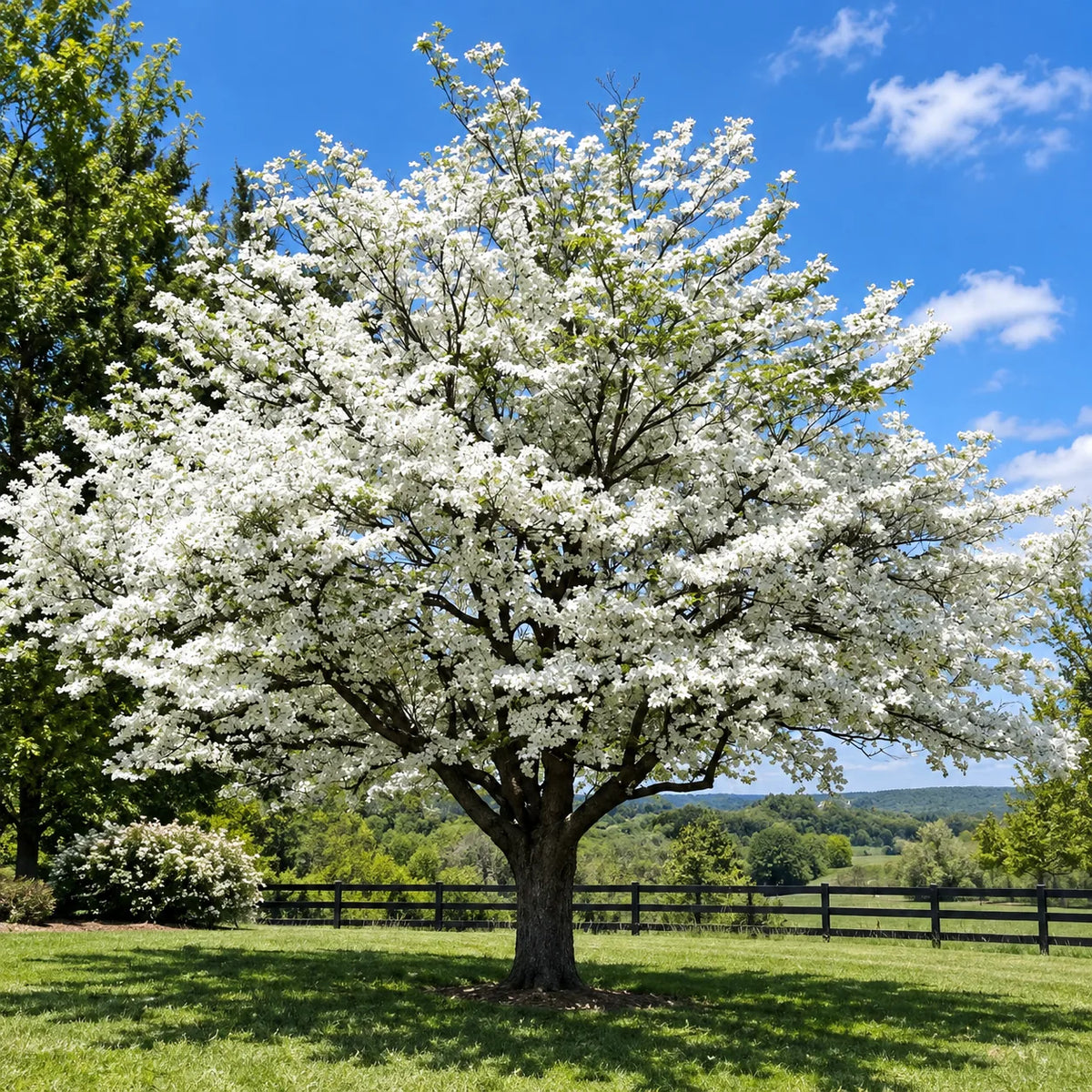
Quick answer: The best time to plant a dogwood tree is fall, so roots can establish before summer heat. Bare-root and balled-and-burlapped dogwoods should go in while dormant, roughly November through March, while container-grown trees can be planted almost any time if watered carefully. Plant high, in partial shade and moist, acidic soil.
Quick facts
| Botanical name | Cornus florida (flowering dogwood); Cornus kousa (kousa dogwood) |
|---|---|
| Best planting time | Fall; bare-root and B&B while dormant (about Nov–Mar) |
| USDA zones | Flowering dogwood 5–9; kousa dogwood 5–8 |
| Sun | Partial shade, ideally shade from hot afternoon sun |
| Soil | Moist, well-drained, high in organic matter; never soggy |
| Soil pH | Acidic, about 5.2–6.0 |
| Water | Deep soak once or twice a week in dry weather for the first two seasons (about 1–2 in. per week) |
| Mature size | Flowering dogwood 15–30 ft tall, often as wide or wider; kousa 15–30 ft tall and wide |
| Bloom time | Flowering dogwood April–May (late March in the Deep South); kousa a few weeks later |
| Native range | Flowering dogwood: eastern United States |
Dogwoods are one of the most-asked-about trees we grow, and the most common question is simple: when should I plant one? The short version is fall, but the right answer also depends on how your tree is sold (bare root, balled and burlapped, or in a pot) and where you put it. This guide covers timing, site, planting depth and first-year care, based on extension research from the Southeast, where flowering dogwood is native. Not sure of your zone? Check it with our free planting zone calculator.
When is the best time to plant a dogwood tree?
Fall is the best time to plant a dogwood tree. Alabama Cooperative Extension and Clemson Extension both say fall planting gives roots time to settle in before the stress of the first summer.
In fall the soil is still warm, so new roots keep growing after the leaves drop, while the cooler air means the tree loses less water. By the time spring arrives, a fall-planted dogwood already has a head start on the summer heat and dry spells that kill many young trees.
Late winter and early spring are the next-best choice, as long as the tree goes in before it leafs out and you can keep up with watering through its first summer.
Does the planting time change for bare-root, B&B or potted dogwoods?
Yes. Bare-root and balled-and-burlapped (B&B) dogwoods should be planted while dormant; container-grown dogwoods are more flexible.
- Bare-root: plant while dormant, before buds break. The University of Georgia gives the dormant window as November through March. Our white dogwood seedlings and kousa dogwood seedlings ship bare root in the dormant season for this reason.
- Balled and burlapped: Alabama Extension recommends planting while dormant, from November to February.
- Container-grown: UGA says potted dogwoods "can be planted anytime" if they are watered carefully, and Alabama Extension says year-round planting is possible. Fall is still best. Clemson notes container plants establish faster than field-dug B&B trees.
Where should you plant a dogwood?
Plant a dogwood where it gets morning sun and afternoon shade, in moist but well-drained soil. That mimics its natural home at the edge of hardwood forests.
- Light: Clemson says flowering dogwood prefers partial shade, especially in the hot afternoon, though it tolerates full sun. Alabama Extension warns that trees in full sun are more likely to be attacked by dogwood borers, and UGA notes that dense shade leads to poor flowering. An east- or north-facing spot under tall trees is ideal.
- Soil: Moist, well-drained soil high in organic matter. UGA says dogwoods never do well on poorly drained sites. If water stands after rain, pick another spot or plant on a raised bed.
- pH: Acidic. Alabama Extension gives an optimal range of 5.2 to 6.0; Clemson gives 5.5 to 6.0.
- Room: Mature canopies can be 15 to 30 feet across, so give the tree space and keep it well away from the house.
How do you plant a dogwood tree?
Dig a wide, shallow hole and set the tree so its top roots are level with or slightly above the surrounding ground. Planting too deep is one of the most common reasons dogwoods fail.
- Dig wide, not deep. Alabama Extension recommends a hole two to three times wider than the root ball and slightly shallower than its height.
- Find the root flare. On potted trees, brush away soil until you find the topmost roots. They should end up at grade, or "better still," slightly above it.
- Set bare-root trees carefully. Spread the roots out and keep the highest root even with or slightly above the soil line. See our bare-root planting guide for soaking and setting roots.
- Backfill with native soil. Firm it gently to remove air pockets. UGA advises putting organic matter on top as mulch rather than mixing it into the hole.
- Water deeply to settle the soil.
- Mulch. Spread 2 to 4 inches of pine straw, pine bark or shredded leaves in a wide ring (Clemson suggests at least 8 to 10 feet across), keeping it off the trunk.
How often should you water a newly planted dogwood?
Water a new dogwood deeply once or twice a week during dry weather for its first two growing seasons. Clemson recommends about 1 to 2 inches of water per week in dry periods.
Dogwoods are shallow-rooted, and UGA says most of their roots sit in the top 12 inches of soil. That is why drought hits them hard. UGA goes so far as to say that water in the first two seasons "may determine whether dogwood trees live or die." At the same time, watering too often can rot the roots, so soak the soil and then let the top inch or two dry before watering again. Keep watering through dry fall weather; Alabama Extension says winter watering is rarely needed.
Should you fertilize a dogwood at planting?
No. Alabama Extension says little if any fertilizer is needed in the first growing season, and too much nitrogen early can stunt root growth.
UGA puts it bluntly: many recently planted trees are killed by heavy fertilization. Wait until the second year, then feed lightly in spring based on a soil test. Clemson suggests an acid-forming, azalea-type fertilizer applied lightly after the last frost. Our fertilizer feeding calculator can help you size a light dose.
Can you grow a dogwood tree indoors?
Not long term. Dogwoods are outdoor trees that need full seasons, including winter dormancy, and none of the extension guides we reviewed recommend growing them as houseplants.
If you are holding a bare-root or potted dogwood before planting, keep it in a cool, sheltered spot such as an unheated garage or a shaded porch, keep the roots moist, and plant it outdoors as soon as the ground can be worked. A young dogwood can live in a large container outdoors for a season or two, but it will grow best in the ground.
Which dogwood should you plant: flowering or kousa?
Plant flowering dogwood (Cornus florida) for a native tree that blooms before it leafs out; plant kousa dogwood (Cornus kousa) for later blooms and better disease resistance.
- Flowering dogwood: native to the eastern U.S., zones 5 to 9, white bracts in April and May (Clemson), scarlet fall fruit eaten by birds, and red-purple fall color. Pink and red forms include our pink dogwood and red dogwood.
- Kousa dogwood: native to Asia, zones 5 to 8, blooms a few weeks later after the leaves emerge, with raspberry-like pinkish-red fruit. Clemson and UF/IFAS say kousa is more resistant to dogwood anthracnose and powdery mildew, and it handles afternoon sun better, though it does not tolerate drought.
Browse every option in our dogwood trees collection.
What problems should you watch for after planting?
The biggest threats to young dogwoods are drought stress, dogwood borers and leaf diseases such as dogwood anthracnose and powdery mildew.
- Dogwood anthracnose: UF/IFAS calls it the biggest concern. It is favored by cool, wet spring or fall weather and hits drought-stressed trees hardest. Choose a site with good air flow and keep the tree watered.
- Powdery mildew: a white coating on leaves in summer; resistant cultivars and kousa dogwoods suffer less.
- Dogwood borers: Alabama Extension calls them one of the main causes of death. They enter through wounds, so keep mowers and string trimmers away. UGA suggests three short stakes about 6 inches from the trunk as a guard.
For more on bare-root dogwoods, read our white dogwood bare-root fall planting guide, and see what the tree looks like through the year in the four seasons of dogwood trees.
Frequently asked questions
What month is best to plant a dogwood tree?
Fall is best, once summer heat has passed but while the soil is still warm. Bare-root and balled-and-burlapped dogwoods can be planted any time they are dormant, roughly November through March.
Can you plant a dogwood in spring?
Yes. Plant in early spring before the tree leafs out, and water it faithfully through its first summer. Fall planting is still preferred because roots establish before summer heat.
Can you plant a dogwood in summer?
Only container-grown dogwoods, and only if you can water them deeply once or twice a week. Summer is the riskiest time because of heat and drought stress.
How deep should you plant a dogwood tree?
Set the top roots level with or slightly above the surrounding soil. Dig the hole two to three times wider than the root ball but no deeper than it.
Do dogwoods like sun or shade?
Flowering dogwoods prefer partial shade, especially shade from hot afternoon sun. Trees in full sun are more prone to borers and drought stress, while dense shade reduces flowering.
How fast does a dogwood tree grow?
Slowly. Clemson Extension cites flowering dogwood reaching about 15 feet in 18 years, and kousa dogwood about 10 feet in 15 years.
What soil pH do dogwoods need?
Acidic soil, about pH 5.2 to 6.0, that is moist, well drained and rich in organic matter.
Can a dogwood tree be grown indoors?
No. Dogwoods need outdoor seasons and winter dormancy. Store bare-root or potted trees in a cool, sheltered spot only briefly, then plant them outdoors.
Shop dogwood trees


TN Nursery has grown trees in Tennessee since Roscoe Tate founded the nursery in 1959. Plant your dogwood this fall, keep it watered through two summers, and it will reward you with spring blooms for decades.


