
Published November 2026. Want shade, privacy or a windbreak in a few years instead of a few decades? The fastest-growing trees can put on two feet or more in a single season, but only if they're hardy where you live. A tree that races ahead in Tennessee can stall out in Minnesota, and a Northern favorite can struggle in a Gulf Coast summer. Below are our fastest-growing trees sorted by USDA planting zone, with the zone range, mature height and growth rate for each. Every tree links to its product page, and you can browse everything in our fast-growing trees collection or the full trees collection.
Start with your zone
- Don't know your zone? Enter your ZIP code in our free plant hardiness zone finder.
- Prefer a map? Click your state on our plants by state zone map.
- Then jump to your section: Zones 2–4 · Zones 5–6 · Zones 7–9
What Counts as a Fast-Growing Tree?
Tree growers commonly sort trees into three growth rates: slow (12 inches or less a year), medium (13 to 24 inches) and fast (25 inches or more). We use that scale below. Growth rate depends on more than the tree. Full sun, steady moisture in the first two summers and a wide mulch ring all push a young tree toward the top of its range. Most of the trees on this list want at least six hours of direct sun.
Fast-Growing Trees at a Glance
| Tree | Planting zones | Mature height | Growth rate |
|---|---|---|---|
| Silver maple | 3–9 | 50–80 ft | Fast |
| Cottonwood | 2–9 | Over 25 ft | Fast |
| Box elder | 2–9 | 30–50 ft | Fast |
| Lombardy poplar | 3–9 | 40–60 ft | Fast |
| Weeping willow | 4–9 | Over 25 ft | Fast |
| River birch | 4–9 | 40–70 ft | Fast |
| Tulip poplar | 4–9 | Over 25 ft | Fast |
| Sycamore | 4–9 | Over 25 ft | Fast |
| Catalpa | 4–8 | 40–60 ft | Fast |
| Red maple | 3–9 | 40–60 ft | Medium to fast |
| Red Sunset maple | 4–8 | 40–50 ft | Medium to fast |
| White pine | 3–8 | 50–80 ft | Medium to fast |
| Bald cypress | 4–10 | 50–70 ft | Medium to fast |
| Sweet gum | 5–9 | Over 25 ft | Medium to fast |
| Natchez crepe myrtle | 7–9 | 20–30 ft | Medium to fast |
Zones and mature heights are from each tree's product page. Growth rates use the slow, medium and fast scale above and are typical for young trees in good conditions.
Fastest-Growing Trees for Zones 2–4
Cold-zone gardeners have fewer choices, but the ones that are hardy here grow with real vigor. Cottonwood and box elder are both rated down to zone 2. Cottonwood loves moist ground along creeks and low spots, and box elder handles tough, open sites where other trees struggle. Give both plenty of room. We recommend planting box elder at least 30 feet from buildings, drives and power lines.
From zone 3, silver maple is one of the quickest shade trees you can plant, eventually reaching 50 to 80 feet. Red maple grows a little slower but gives you red spring flowers and brilliant fall color. Lombardy poplar shoots straight up into a narrow column, which makes it a fast windbreak or screen. For an evergreen, white pine seedlings are an affordable way to plant a lot of trees at once, and they pick up speed after their first couple of years.
Zone 4 adds weeping willow, river birch, tulip poplar, sycamore and catalpa, which are covered in the next section.
Fastest-Growing Trees for Zones 5–6
This is where the list gets long. Every tree in the zones 2–4 section still grows well here, and several more come into their own:
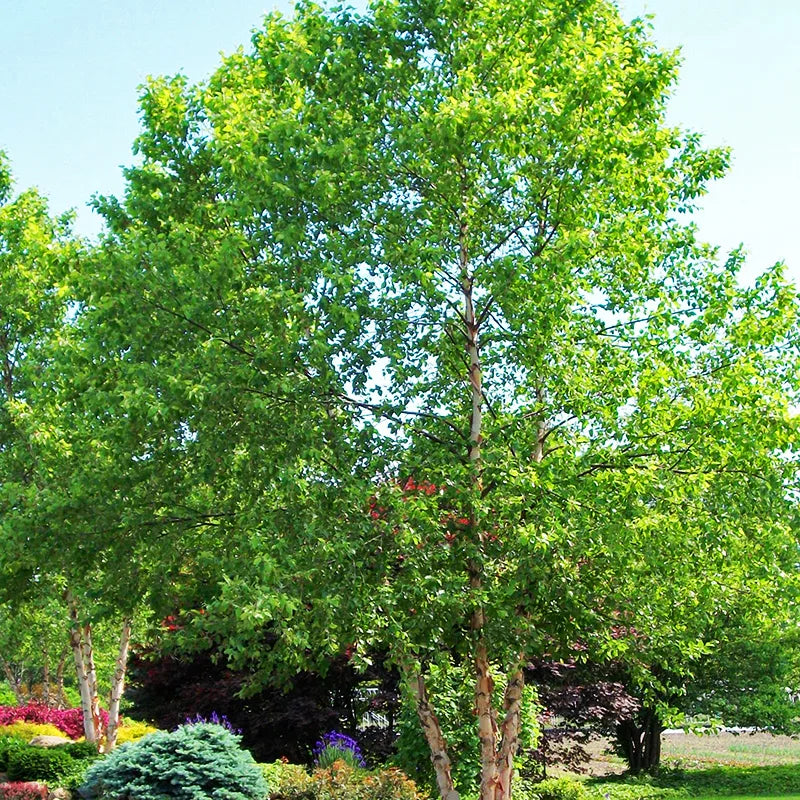
- River birch (zones 4–9) is fast, tolerates wet soil and has peeling cinnamon bark that looks good all winter.
- Tulip poplar (zones 4–9) grows tall and straight and covers itself in yellow-green tulip-shaped flowers in spring. Bees love it.
- Weeping willow (zones 4–9) is a classic for ponds and low, damp spots and is one of the fastest trees we sell.
- Sycamore (zones 4–9) becomes a huge shade tree with white, patchy bark.
- Catalpa (zones 4–8) grows quickly, has big heart-shaped leaves and puts out showy white flowers in late spring. Plant it at least 15 feet from buildings, patios and drives.
- Red Sunset maple (zones 4–8) is one of the faster maples, with dependable orange-red fall color.
- Bald cypress (zones 4–10) grows well in both wet and ordinary soil and turns rusty orange in fall.
- Sweet gum (zones 5–9) brings star-shaped leaves and some of the best fall color of any shade tree.
Fastest-Growing Trees for Zones 7–9
Warm-zone gardeners get the longest growing season, and that extra time shows. Here in middle Tennessee, much of which is now zone 7b on the 2023 USDA map, a well-sited river birch or tulip poplar can add several feet of growth in a year once it's established. Nearly everything above grows here too, except catalpa and Red Sunset maple, which top out at zone 8.
This is also crepe myrtle country. Natchez crepe myrtle (zones 7–9) reaches 20 to 30 feet with white summer flowers and cinnamon bark, and our pink, red, purple and Muskogee crepe myrtles are quick, colorful choices for smaller yards. For a large native shade tree, bald cypress and sweet gum both handle Southern heat well, and cedar elm (zones 6–9) is a tough native shade tree for hot, dry sites.
Tips to Get the Fastest Growth
- Plant during dormancy. Late fall through early spring lets roots settle in before the first summer. Most of our trees ship bare root, and a bare-root tree planted while dormant gets the best start.
- Water deeply the first two summers. A long soak once or twice a week beats a daily sprinkle.
- Mulch, don't pile. Spread 2 to 3 inches of mulch in a wide ring, and keep it a few inches off the trunk.
- Give them room. Fast trees get big fast. Check the mature height on each product page before you pick a spot.
- Choose the middle of the range. A tree whose zone range puts your zone near the middle has a cushion against both hard winters and hot summers.
Why Buy From TN Nursery
TN Nursery was founded in 1959 by Roscoe Tate and grows trees on 170 acres in Tennessee. We've grown more than 200,000 redbuds and about 2 million pawpaw trees, and our trees have been planted by customers including Arlington National Cemetery and the Washington Monument grounds. Every tree on this list ships from our fields.
Ready to plant? Shop our fast-growing trees, browse all trees, or see native trees. To learn how zones are shifting, read our study of hardiness zone changes by ZIP code.
Sources
- USDA Agricultural Research Service. USDA Plant Hardiness Zone Map (2023).


