
The short answer
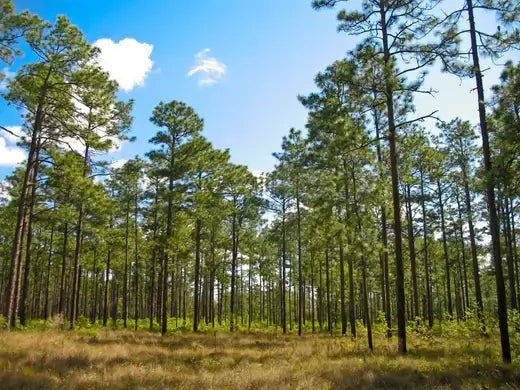
A yellow pine tree is one of several hard pines grown for strong timber. In the West it means ponderosa pine. In the South it means the southern yellow pines: loblolly, longleaf, shortleaf, slash and Virginia pine. All are tall, sun-loving evergreens with needles in bundles of two or three.
Yellow pines are some of the tallest, longest-serving trees you can plant. Ponderosa reaches 60 to 125 feet, longleaf 60 to 120 feet and loblolly 60 to 90 feet, so each one needs open sky and plenty of room to spread. Their deep roots reach down for moisture in the soil below, and their bark thickens into broad, scaly plates as they age. Yellow pine is a softwood, like every pine, and its strong lumber is widely used for framing, decking and flooring. Planted along a property line, a row of young pines grows into a tall evergreen screen and windbreak that stays green all winter. This 2026 update explains what yellow pine means, how to tell the species apart, where each one thrives and when to plant bare-root seedlings. The needle, cone, height and zone figures come from NC State Extension's plant records, and the planting dates from state forestry agencies.
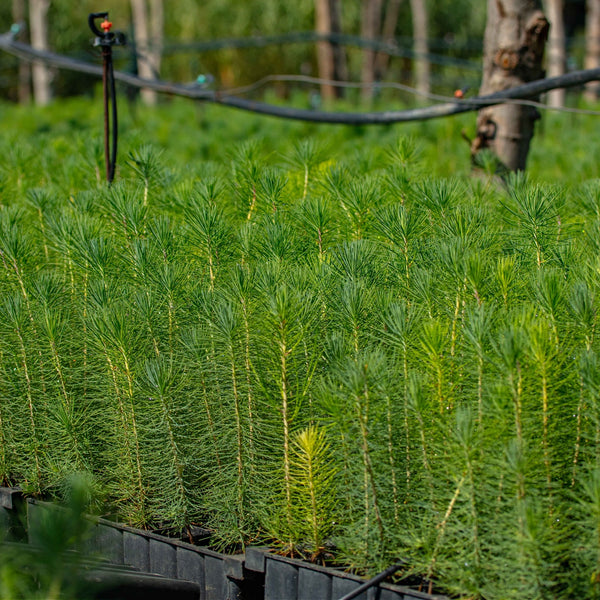
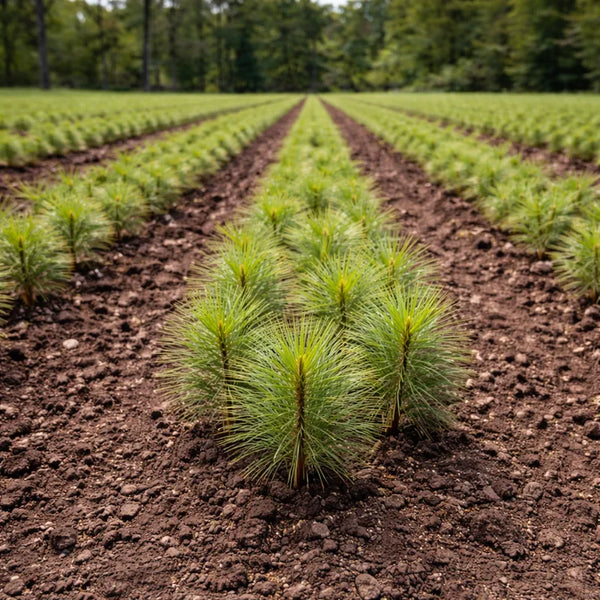
Yellow pine tree seedlings to plant

1. Pick your dormant-season planting window
Plant bare-root pines while they are dormant. Across the lower South, the Alabama Forestry Commission sets the window at December through March, and Texas A&M Forest Service gives December 15 to March 15 for East Texas. Farther north, Penn State Extension plants from early March to early May, once frost is out of the ground and before buds break. Plant on days when the soil is workable.
Tip: Earlier in the window gives new roots more weeks to grow before summer heat.
2. Keep the roots moist until planting
Plant your seedlings as soon as they arrive, ideally within 24 hours and no later than a week, as Penn State Extension advises. Until then, keep the bundle in a cool, shaded spot with the roots damp and covered, out of sun and drying wind. Carry seedlings around the site in a bucket or bag so the roots stay moist while you work.
Tip: Open the bundle only when you are ready to plant.
3. Space seedlings for their full size
Give each pine room to reach its mature height and spread. The Alabama Forestry Commission lists common spacings from 7 by 10 feet (622 seedlings per acre) to 12 by 12 feet (302 per acre), and longleaf is usually planted wider than loblolly. For a property-line screen, set one row along the line, well inside the boundary, so mature branches stay on your land.
Tip: Mark each planting spot with a flag before planting day.
4. Plant at the root collar
Open a slit or hole deep enough for the whole root system. Set the seedling at the depth it grew in the nursery, with the root collar at the soil line, and let the roots hang straight down rather than balled or bent, as Penn State Extension recommends. Close the hole and firm the soil around the stem with your heel, then check that the seedling stands upright.
Tip: Tug a needle gently: a well-firmed seedling stays put.
Loblolly or Virginia pine
Our two yellow pine seedlings suit different sites. Loblolly pine is the fast one: NC State Extension calls its growth rate the most rapid of all pines, and it reaches 60 to 90 feet in Zones 6 to 9. It thrives in full sun and moist, acidic soil, including heavier ground that stays damp, so it suits quick screens and windbreaks across the Southeast. Virginia pine is the cold-hardy one. It tops out at 40 to 80 feet, grows in Zones 4 to 8, and thrives in sandy, acidic loam while settling happily into poor, dry, eroded or clay soils that drain well, according to NC State's Virginia pine record. Its short, twisted needles come in pairs, and its crown turns flat-topped with age. Choose loblolly for speed and size in the warm South, and Virginia pine for colder sites and for thin, dry or clay ground where a hardy evergreen is the goal.
Care and keeping
Through the first growing season, water new seedlings deeply whenever the soil dries out, soaking the root zone rather than the needles. A thin layer of pine straw or wood chips around each one, kept back from the stem, holds moisture in. Keep grass and weeds pulled back so the young pine thrives in full sun.
Frequently asked questions
What's the difference between pine and yellow pine?
Every yellow pine is a pine, but not every pine is a yellow pine. Yellow pine names a group of hard pines with needles in bundles of two or three, such as ponderosa and the southern yellow pines. Soft pines such as eastern white pine carry their needles in fives. All pines, yellow ones included, are softwoods.
Where do yellow pine trees grow?
Ponderosa, the western yellow pine, grows from British Columbia south to Mexico and east to North Dakota and Texas, in Zones 3 to 7. The southern yellow pines grow across the Southeast, from Pennsylvania and New York south to Florida and west to Texas and Oklahoma, mostly in Zones 6 to 9.
What are the pine trees that turn yellow called?
Any pine can turn partly yellow in autumn. This is seasonal or fall needle drop: the oldest inner needles yellow and fall while branch tips stay green, as Michigan State University Extension explains. It is a natural response to shorter days and cooler nights, much like leaf drop on deciduous trees.
What yellow pine means: western (ponderosa) vs southern
Yellow pine is a common and lumber name, not a single species. In the western United States and Canada it means ponderosa pine, Pinus ponderosa, also called western yellow pine. The U.S. Fish and Wildlife Service points to its thick orange bark, which flakes off in pieces like a jigsaw puzzle. In the South, yellow pine means the southern yellow pines: loblolly, longleaf, shortleaf and slash pine as the main four, with Virginia pine counted among them in this guide. All of them are hard pines, and their wood is sold as softwood lumber.
The southern yellow pines
Loblolly pine (Pinus taeda)
Loblolly grows faster than any other pine, according to NC State Extension. It reaches 60 to 90 feet, carries yellow-green needles 6 to 10 inches long in threes, and thrives in full sun and moist, acidic soil, including ground that stays damp.
Longleaf pine (Pinus palustris)
Longleaf has the longest needles and biggest cones of the group: needles 6 to 12 inches in threes and cones 6 to 15 inches, per NC State Extension. It spends its first years in a low, grass-like stage building its stem, then climbs to 60 to 120 feet. It thrives in well-drained sandy or clay soil in full sun.
Shortleaf pine (Pinus echinata)
Shortleaf carries slender, flexible needles 3 to 5 inches long in twos or threes, with small cones of 1.5 to 2.5 inches, per NC State Extension. It grows 80 to 100 feet tall and thrives in dry to medium, well-drained soil in full sun.
Slash pine (Pinus elliottii)
Slash pine is tall and slender, with flexible dark blue-green needles 5 to 11 inches long in twos and threes and glossy cones of 3 to 6 inches, per NC State Extension. It grows fast and thrives in the sandhills and flatwoods from North Carolina to Texas and Florida.
Virginia pine (Pinus virginiana)
Virginia pine has the shortest needles of the group, 1.5 to 3 inches, twisted and in pairs, per NC State Extension. It grows 40 to 80 feet, turns flat-topped with age, and thrives on poor, dry or clay soils that drain well.
How to identify yellow pine
Start with the needles. Count how many grow from each papery sheath: yellow pines carry two or three, while eastern white pine, a soft pine, carries five. Our white pine seedlings in the first row above are that five-needle soft pine, for anyone weighing the two. Then measure needle length and check the cones. Long needles and big cones point to longleaf, and short twisted pairs point to Virginia pine. Mature bark is the last clue, as most yellow pines develop reddish-brown to orange-brown scaly plates.
| Species | Needle length | Needles per bundle | Cone length | USDA zones |
|---|---|---|---|---|
| Ponderosa | 5–10 in | 3 | 3–6 in | 3–7 |
| Loblolly | 6–10 in | 3 | 3–6 in | 6–9 |
| Longleaf | 6–12 in | 3 | 6–15 in | 7b–9 |
| Shortleaf | 3–5 in | 2 or 3 | 1.5–2.5 in | 6–9 |
| Slash | 5–11 in | 2 or 3 | 3–6 in | 8–11 |
| Virginia | 1.5–3 in | 2 | 1.5–3 in | 4–8 |
Needle length
- Ponderosa
- 5–10 in
- Loblolly
- 6–10 in
- Longleaf
- 6–12 in
- Shortleaf
- 3–5 in
- Slash
- 5–11 in
- Virginia
- 1.5–3 in
Needles per bundle
- Ponderosa
- 3
- Loblolly
- 3
- Longleaf
- 3
- Shortleaf
- 2 or 3
- Slash
- 2 or 3
- Virginia
- 2
Cone length
- Ponderosa
- 3–6 in
- Loblolly
- 3–6 in
- Longleaf
- 6–15 in
- Shortleaf
- 1.5–2.5 in
- Slash
- 3–6 in
- Virginia
- 1.5–3 in
USDA zones
- Ponderosa
- 3–7
- Loblolly
- 6–9
- Longleaf
- 7b–9
- Shortleaf
- 6–9
- Slash
- 8–11
- Virginia
- 4–8
Every figure comes from NC State Extension's plant records for ponderosa, loblolly, longleaf, shortleaf, slash and Virginia pine.
Where each yellow pine grows and its USDA zones
- Ponderosa: mountains from southwest Canada to northern Mexico, east to North Dakota and Texas. Zones 3 to 7.
- Loblolly: the southeastern United States. Zones 6 to 9.
- Longleaf: Virginia west to Texas and south to Florida. Zones 7b to 9.
- Shortleaf: southeastern New York west to eastern Oklahoma, south to Texas and northern Florida. Zones 6 to 9.
- Slash: North Carolina to Texas, including Florida. Zones 8 to 11.
- Virginia: Pennsylvania southwest to Missouri, south to Mississippi and Georgia. Zones 4 to 8.
Ranges and zones follow NC State Extension's plant records. For cold northern sites, Virginia pine and ponderosa reach the farthest north; for the warm Gulf Coast, slash and longleaf feel most at home.
How fast yellow pines grow
Loblolly is the quickest, with the most rapid growth rate of all pines. Slash and shortleaf also grow fast, ponderosa grows at a medium pace, and Virginia pine grows more slowly than most pines. Longleaf takes its own path: it stays in a grass-like stage for about its first five years, then shoots upward. These rates come from NC State Extension. For a fast screen, pick loblolly; for a long-lived specimen, longleaf repays the wait.